The dawn of 6G is upon us, with the mobile ecosystem entering a critical phase of technical definition and coordination. Organizations such as the 3rd Generation Partnership Project (3GPP), the AI-RAN Alliance, and the O-RAN ALLIANCE are now making aligned efforts to shape what will become the first wide-scale AI-native generation of wireless networks.
Each new wireless generation pushes the boundaries of possibility. In this evolving landscape, artificial intelligence (AI) is emerging not merely as a supporting technology but as a foundational enabler of next-generation wireless systems. AI promises to make networks more adaptive, efficient, and intelligent, transforming the way radio access networks (RAN) are designed and operate.
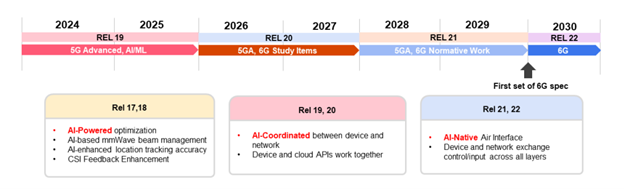
AI capabilities first appeared in 3GPP Release 17 and expanded in Release 18. Upcoming releases are expected to transition from AI-coordinated networks — where AI manages discrete network functions — to AI-native architectures, where AI is deeply embedded throughout the network stack (Figure 1). In 6G, AI will likely permeate every layer, unlocking unprecedented levels of performance and automation. While 3GPP does not address every layer, innovation is advancing across the stack, with some vendors and operators already deploying AI models directly within their networks.
AI’s Role in the RAN
AI holds strong promise for the radio access network, offering gains in network efficiency and quality of service while enabling the deployment of AI models locally. According to the AI-RAN Alliance, while traditional RAN architectures meet the needs of current telecom systems, AI has the potential to significantly enhance RAN automation and performance.
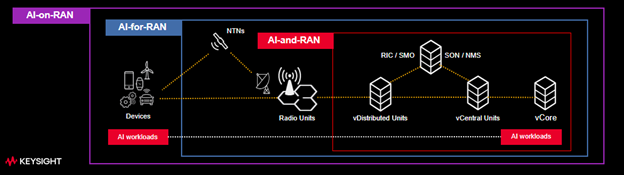
The AI-RAN landscape encompasses several related but distinct concepts (Figure 2):
- AI-for-RAN applies AI to improve spectrum usage, reduce costs, and enhance energy efficiency.
- AI-and-RAN focuses on the convergence of AI and the RAN to maximize infrastructure utilization.
- AI-on-RAN explores new AI-native services and applications in wireless networks.
In parallel, the O-RAN ALLIANCE is advancing open, modular, and intelligent RAN architectures. Its work centers on disaggregated components, multi-vendor interoperability, and intelligent control through platforms like the RAN Intelligent Controller (RIC).
Each organization contributes to the development of AI-native 6G networks:
- 3GPP defines the global standards for air interfaces, core / RAN architectures, and AI / ML lifecycle management.
- The AI-RAN Alliance leads experimental work, pioneering new AI-embedded architectures, use cases, benchmarks, and prototype systems.
- The O-RAN ALLIANCE builds on the 3GPP standards, driving deeper disaggregation in the network through modular deployment frameworks.
The AI-RAN Alliance can be viewed as an innovation sandbox—creating validated blueprints and reference architectures that not only inform and accelerate O-RAN technical specifications but also address aspects beyond the scope of both O-RAN and 3GPP. Joint use case validation, harmonized APIs, and ecosystem-wide testing will be critical to ensure the practical deployment of AI-native technologies.
Design and Test: The Role of Digital Twins
As AI becomes a core element of RAN design, network complexity rises exponentially. Engineers must rigorously test and validate AI models under diverse, real-world conditions before deployment. This requires advanced simulation tools that replicate realistic environments using synthetic and measured data.
This is where network digital twins become essential. Traditionally used post-deployment, digital twins will take center stage in 6G for pre-deployment simulation and validation. These virtual replicas must emulate the entire network—from RF propagation and base stations to the core — to ensure comprehensive test coverage. They support design at every layer of the communication network but are especially valuable for the higher layers responsible for network management and efficiency.
Accurate site-specific RF propagation scenarios and channel models are particularly critical for AI-RAN. They allow engineers to simulate and visualize drive test routes with high fidelity, ensuring AI models are trained and validated under realistic conditions, which is especially important for AI models operating at the physical layer.
RF raytracing tools like Keysight’s RaySim play a vital role in this workflow. RaySim generates detailed site-specific datasets to train AI / ML models and benchmark AI-RAN and AI-device use cases more quickly. It also leverages NVIDIA’s Aerial Omniverse Digital Twin platform to model deployment scenarios in 3D.
Conclusion
The journey toward 6G will be defined by how effectively the industry integrates AI into the RAN. Success depends not only on new technologies but also on interdisciplinary collaboration and advanced tools.
AI-RAN innovation requires expertise in RF modeling, network emulation, simulation, and accelerated computing. As 6G development accelerates, enabling teams to design, test, and optimize AI-driven RAN systems will be critical to realizing the full potential of next-generation wireless.
- Innovating for 6G: The Potential of AI to Enhance RAN Performance - September 1, 2025
- The 5GC Network Revolution: MEC and SBA Testing - November 5, 2019