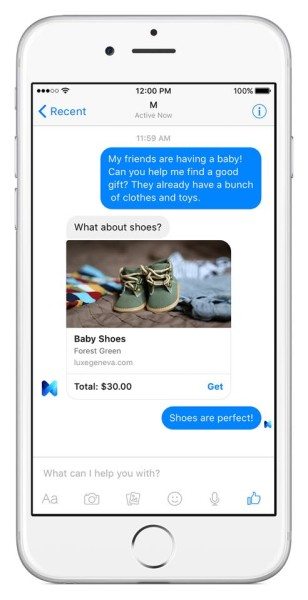
You know what this world needs? More digital personal assistants.
OK. Maybe not. But Facebook is launching a new one anyway: Facebook M.
Facebook M is unique among its peers in that there are actual human beings driving the concierge service behind the scenes. That has benefits but also presents interesting challenges. I wrote this post about the challenges Facebook M faces:
Facebook has launched its own challenger to go head-to-head with personal digital assistants like Apple’s Siri and Microsoft’s Cortana. The Facebook assistant is a function of the Facebook Messenger app and is dubbed simply “M”. M has a number of unique features and benefits that set it apart from rivals and make it a potentially more valuable service, but Facebook has some major hurdles to cross in order for M to gain any mainstream traction.
David Marcus, vice president of messaging products at Facebook, shared some details about the new service in a Facebook post yesterday. He explained that M is powered by artificial intelligence like competing services from Apple, Google and Microsoft, but that it also has trained and supervised human beings behind it. “Unlike other AI-based services in the market, M can actually complete tasks on your behalf. It can purchase items, get gifts delivered to your loved ones, book restaurants, travel arrangements, appointments and way more.”
That makes a big difference in the overall service. I can ask Siri or Cortana where the nearest flower shop is located, or say I’m hungry for a pizza and those services will locate information I can use to drive to a flower shop or call and order a pizza. M goes a step further and can actually order the flowers or pizza for me. It’s more of a personal concierge service than a personal digital assistant.
M is able to do that because there are human beings on the other end of those requests. Questions like “What is the weather today?” may be quickly and easily answered by a computer-generated response through artificial intelligence. However, other queries such as “It’s my wife’s birthday next week. Can you help me find a great gift?” would probably be handled by an actual person.
A question like that would spark a messaging conversation. You’ll never necessarily know whether it’s an AI or a human being on the other end of your chats with M but the service may ask some follow up questions to clarify what you like—or in this case what sorts of things your wife likes. In the end, though, what really separates M from Siri and Cortana is that after asking those questions M will actually acquire the gift and make sure it gets delivered to you—all wrapped up with a bow and a nice card if you prefer.
I have a passion for technology and gadgets and a desire to help others understand how technology can affect or improve their lives. I also love spending time with my wife, 7 kids, 3 dogs, 5 cats, a pot-bellied pig, and sulcata tortoise, and I like to think I enjoy reading and golf even though I never find time for either. You can contact me directly at tony@xpective.net. For more from me, you can follow me on Threads, Facebook, Instagram and LinkedIn.