We are currently navigating one of the most profound transformative phases in the history of the tech industry. As brilliantly demonstrated by the opening video at the AMD Advancing AI 2026 Keynote in San Francisco, the raw computational power required for modern workloads has scaled astronomically over a remarkably short period. To put this in perspective, just one new AI data center today exceeds the total computing power of the entire world from only a few years ago. AMD’s overarching mission remains heavily focused on pushing performance boundaries to solve the world’s most critical challenges. Artificial intelligence is no longer a fringe experiment; it is deeply involved in healthcare, scientific research, and is fundamentally changing how work gets done across every traditional industry on the planet.
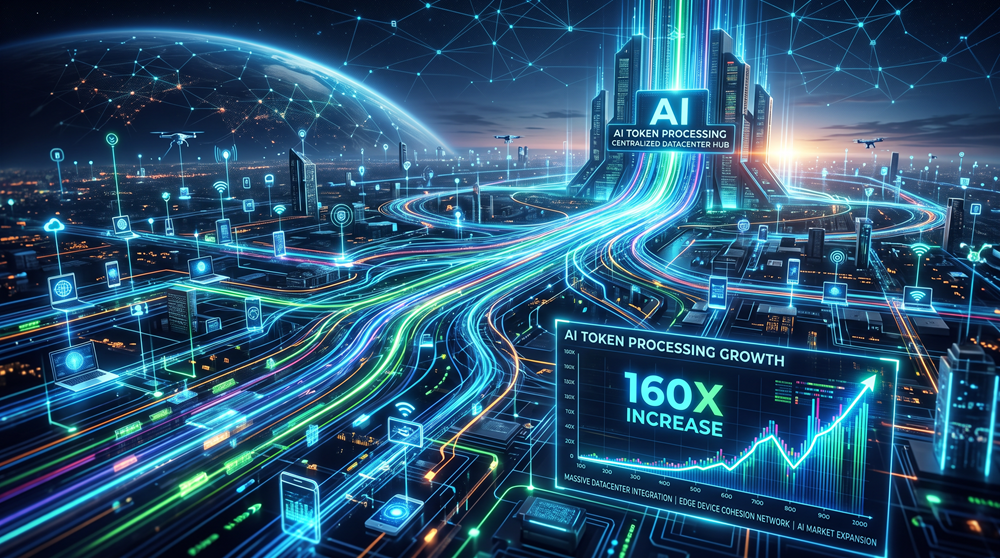
The sheer demand for artificial intelligence infrastructure is increasing massively, creating logistical and engineering hurdles for enterprise IT. We have witnessed nearly a 160x increase in the number of tokens processed over the last two years alone. As large language models naturally yield better reasoning and improved output quality over time, the corporate world is inevitably shifting massive amounts of compute away from merely building and training models toward performing actual production inference. In short, the workload is moving from creating AI to putting it to work. This represents a monumental shift from Generative AI to Agentic AI, where complex, autonomous systems operate independently to solve problems without constant human intervention.
Consequently, this pivot toward Agentic AI is driving massive growth in the accelerator market, which is now growing at an astonishing 45% compound annual growth rate (CAGR) and marching toward a market size projection of $1.4 trillion by 2030. Interestingly, this evolution creates an entirely new growth vector for CPUs as well, with a projected growth of over 50% CAGR targeting a market size of $220 billion by 2030 – a massive jump from around $26 billion today. Additionally, edge AI is experiencing over 40% CAGR, tracking toward a potential $2 trillion market by 2030 as intelligence is pushed outward to devices everywhere. To capture this unprecedented market, AMD’s strategy is elegantly built upon three core priorities: compute leadership, open platforms, and powering AI everywhere.
Taking the Fight to NVIDIA and Intel
In the tech industry, execution is the ultimate differentiator. AMD is heavily leaning into its traditional strengths of architectural flexibility and enterprise integration to conquer these massive TAM projections, and its competitive positioning against both NVIDIA and Intel is arguably stronger than it has ever been. Today, the highly capable AMD EPYC processors power over 60% of the Fortune 100, securing a commanding 46% overall market share in the datacenter space. Intel, now operating under CEO Lip-Bu Tan, has historically dominated this realm, but AMD’s relentless execution has steadily eroded Intel’s stronghold, leaving AMD well-positioned to dominate the next era of compute.
To tackle frontier AI, which demands seamlessly integrated, massive-scale architectures, AMD unveiled Helios, a system engineered specifically for the most powerful frontier models. Helios is not just a collection of disparate parts; it is designed from the ground up to operate as a single integrated system delivering leadership across all critical dimensions. It ranks first in compute, memory, and networking. Packed with an astonishing 320 billion transistors, 432 GB of memory, the advanced CDNA 5 architecture, and a blend of 2nm and 3nm process nodes, Helios stakes a legitimate claim as the absolute best AI rack globally. Compared to its predecessors, it delivers 15% more compute, 50% more High Bandwidth Memory (HBM) capacity, and 50% more scale-out bandwidth. Currently in full production, it directly challenges NVIDIA’s dominance. Notably, AMD’s leadership highlighted that Helios provides 10% to 15% better performance than NVIDIA’s Vera Rubin NVL72, striking a significant blow in the performance wars.
On the CPU front, AMD’s EPYC Turin already stands as the highest-ranked CPU by raw performance. However, the newly announced 6th Generation EPYC “Venice” processor completely changes the game for Agentic AI workloads. Taking the acclaimed Zen6 architecture across their entire portfolio, Venice is an incredible 1.8x faster than Turin. In a three-segment server market—comprising GPU servers, agent sandboxes, and general-purpose enterprise servers—EPYC is the only CPU that leads comprehensively across all three segments. Against ARM competitors, Venice delivers over double the agents per watt. Against NVIDIA’s Vera CPU, it pushes 1.2x single-core performance and up to 2.2x greater throughput performance. Crucially, the deep software compatibility afforded by the venerable x86 architecture gives AMD a profound operational advantage over competing ARM-based architectures. Rip-and-replace is a swear word in enterprise IT, and AMD’s approach allows IT departments to avoid disruptive software migrations, which explains why customer demand for EPYC Venice is the strongest AMD has ever seen.
Partnerships Rooted in Co-Design and Open Software
What truly sets AMD apart in a highly competitive market is how and why leading technology companies actively prefer working with them. From Anthropic to OpenAI, partners are lining up to leverage AMD Instinct hardware. Tom Brown, co-founder of Anthropic – arguably the most ethical provider in the space – took the stage to praise AMD’s exhaustive efforts in delivering the best chips for their most demanding workloads, confirming Anthropic will be one of the largest users of AMD Helios. Similarly, Sachin Katti from OpenAI confirmed their massive, growing requirement for compute to power increasingly capable and agentic models. OpenAI, notably the first to deploy MI455 racks at scale, praised their collaboration with AMD and plans to deploy Helios at a massive scale deep into 2027. Katti underscored that the open-source nature of AMD’s offering has significantly accelerated OpenAI’s time-to-market, noting that AI is a datacenter problem, not just a rack-level problem.
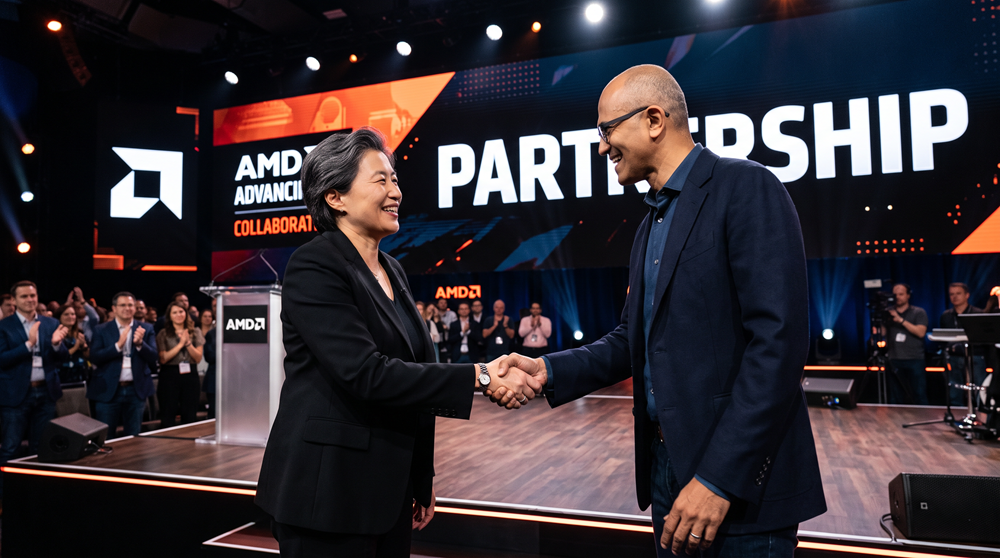
Meta’s head of infrastructure, Santosh Janardhan, further validated this highly collaborative approach. Meta aims to deliver personalized intelligence wherever a user is globally, requiring entire datacenters to be treated as single integrated systems. This demands intensive hardware co-design. Meta views AMD’s willingness to easily and seamlessly collaborate as a critical advantage that proprietary competitors often lack. This partnership, spanning the past four generations of hardware, continues with Meta acting as one of AMD’s broadest lead partners for the Venice architecture.
The inference market is also rapidly segmenting into high batch, cost-optimized, balanced throughput, and ultra-low latency requirements. Disaggregated inference is emerging as a powerful way to deliver the latter. Cerebras co-founder Andrew Feldman highlighted how they are pairing their world’s fastest wafer-scale processor with AMD to reduce latency even further. Launching first in the cloud later this year before moving to on-premises solutions, this combined disaggregated inference solution delivers a massive 5x leap in throughput, proving AMD’s ecosystem is highly adaptable and inclusive.
Software and Internal Innovation as a Competitive Advantage
Hardware is only half the battle; software often dictates the victor in the AI race. AMD’s AI software stack, ROCm, is accelerating open innovation by shifting its release cadence from four months down to an incredibly agile six weeks. Focused on two core principles – open standards and abstraction – ROCm significantly improves developer productivity. This open-source strategy makes development easier on AMD’s platforms and is rapidly evolving into a massive competitive advantage over NVIDIA’s rigidly proprietary software ecosystems.
Furthermore, what I find fascinating is how AMD is utilizing artificial intelligence to automate GPU programming. They announced ROCm AI, which brings AI programming capabilities to developers across a variety of leading AI agents, including Claude, Codex, Cursor, and Gemini. This AI layer helps developers optimize code much faster, yielding a reported 3.3x improvement in coding speed. Major open-source frameworks, including PyTorch, Hugging Face, vLLM, and SGL, are all aggressively praising the performance capabilities of ROCm.AI.
AMD is also “drinking its own champagne,” utilizing AI internally to gain a measurable competitive edge in their own operations. They optimized their own enterprise AI deployments by implementing an advanced orchestrator that intelligently routes tasks to the most appropriate AI models for functions like autonomous threat protection and personal employee agents. This strategic internal implementation reduced their operational token cost by a remarkable 43% while concurrently improving internal performance by nearly 3x.
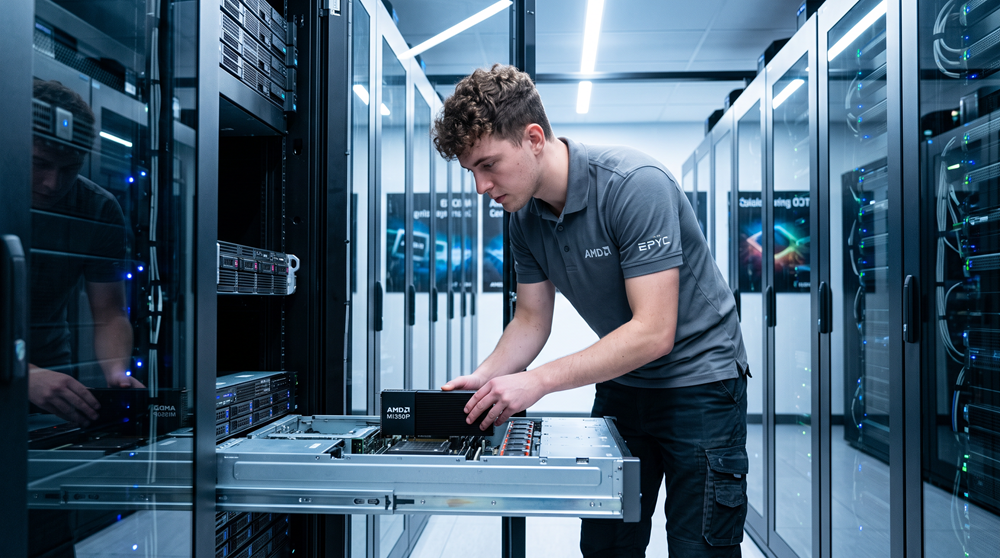
Enterprise customers are paying close attention to this efficiency. AT&T’s CTO, Jeremy Legg, revealed that the telecom giant burns through roughly one trillion tokens per month across 100 different models, handling highly abnormal-scale tasks ranging from customer care to strategic cell tower placement. Validating AMD’s datacenter scale, AT&T announced its OTel 2.0 model was trained exclusively on AMD hardware. Moreover, the newly announced MI350P allows customers to transform existing legacy datacenters into modern AI datacenters through simple modular upgrades, retaining AMD’s signature advantage of avoiding the agonizing pain of “forklift” infrastructure replacements.
Scaling AI to the Edge and the Physical World
During the keynote, Jack Huynh, SVP and GM of Computing and Graphics, highlighted that personal AI agents represent the next massive productivity frontier. While a single agent can double a single person’s output, a multi-capability agent team can drive a 10x to 100x improvement. Because local AI effectively addresses privacy, security, and the high cost of cloud inference, Small Language Models (SLMs) are rapidly closing the performance gap with frontier models.
With advanced edge systems like the Ryzen AI Halo, users can now run incredibly powerful models up to 200 billion parameters locally on a PC. AMD has wisely partnered with Hugging Face – including a free year of the service with every Halo box – solidifying this local ecosystem. The newly announced Gorgon Halo architecture pushes this boundary further, bumping memory from 128GB up to a staggering 192GB alongside numerous other architectural improvements. Recognizing this potential, Cisco’s CTO even suggested a future where all corporate desktop PCs transition entirely to Halo devices, radically increasing endpoint performance while slashing aggregate corporate AI costs.
But AMD is not stopping at the desktop; they are aggressively pivoting into physical AI. Next-generation robotics will not just follow static, pre-programmed scripts; they will increasingly perceive and interact with the physical world autonomously. The AMD Kria AI system-on-module—packing a CPU, NPU, and GPU into one plug-and-play component—is purposefully designed for this agentic robotics era. When pitted against NVIDIA’s highly touted Jenson Thor platform, Kria delivers a 3.4x faster reaction time, supports 2.3x more concurrent agents, and offers 1.6x more CPU capacity. This provides developers a remarkably fast path from imagination to physical deployment, leveraging AMD’s foundational strengths in raw performance, ease of integration, and open software ecosystems.
Wrapping Up
When Dr. Lisa Su returned to the stage to close the keynote, she presented what is undeniably the strongest, most cohesive portfolio in AMD’s storied history. The leadership team’s focus and execution have been nothing short of a strategic masterclass. By laying out a clear, predictable hardware roadmap stretching confidently out to 2028, AMD is signaling that the furious rate of AI innovation will only accelerate, and the real question is whether enterprise IT departments are genuinely ready for the massive changes coming over the next few years.
With a new, more powerful Helios system slated for release every single year, datacenters must be architecturally designed from the ground up for rapid technology churn. AMD has firmly established itself not merely as a reliable, cost-effective alternative to NVIDIA and Intel, but as a premier, deeply collaborative innovator driving the entire industry’s transition into the Agentic AI era. Their unique blend of open platforms, generational compatibility, and relentless performance upgrades ensures that the leading tech companies of the world will continue to build their most ambitious projects on AMD silicon.
- Meta Finalizes Massive Teen Addiction Settlement, but Proposed App Restrictions Make Kids Less Safe - August 28, 2026
- The Aftermath of Corporate Overexpansion - August 25, 2026
- The 2026 Google Pixel 11 Pro Hits Thirty Hours of Battery Life but the New York Keynote Proved Google Wants You to Ignore It - August 21, 2026