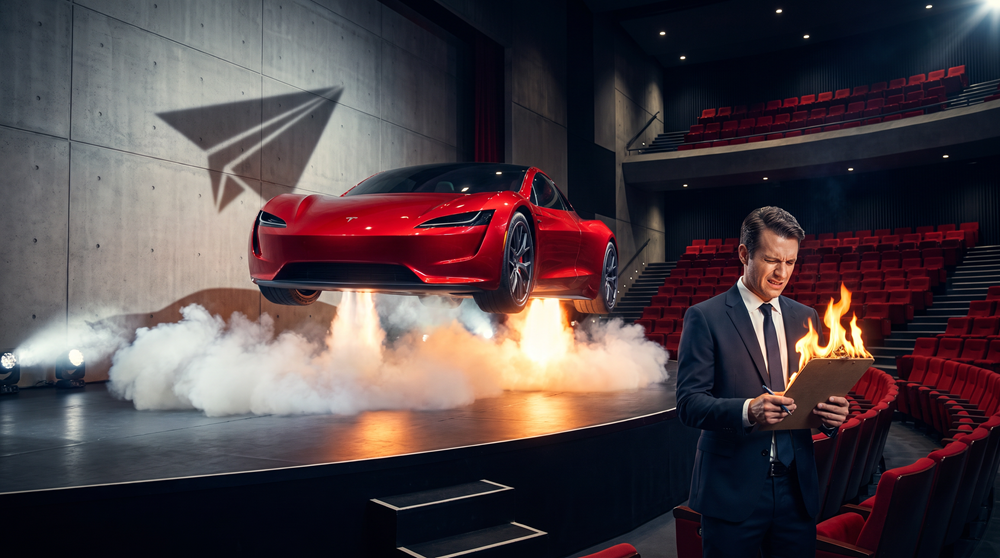
In the technology and automotive sectors, the line between visionary road mapping and outright theatrical deception has grown perilously thin. For decades, Silicon Valley has operated under an unwritten rule: if you can convince investors and the buying public that your revolutionary product is just around the corner, the capital and momentum generated by that belief will eventually allow your engineers to actually build it. We call this “Fake It Till You Make It”.
While that ethos originally emerged as a questionable way to pre-sell software databases, it has migrated into heavy manufacturing, autonomous transportation, and aerospace—industries where physics does not bend to charismatic keynote presentations.
Nowhere is this dynamic more evident than in Elon Musk’s spectacle surrounding the long-delayed, second-generation Tesla Roadster. By showcasing a vehicle that purports to blend electric hypercar performance with SpaceX cold-gas rocket thrusters and vacuum-sealed ground effects – allowing the vehicle to literally hop into the air and stick to ceilings – Tesla has delivered a masterclass in stagecraft. Yet beneath the smoke, mirrors, and compressed air lies a troubling reality. What was presented as an impending halo product is, upon closer inspection, an uninsurable, street-illegal physics experiment that masks massive practical limitations. Worse, it exemplifies how presenting bleeding-edge prototypes as near-production realities puts consumers, investors, and the broader market at severe risk.
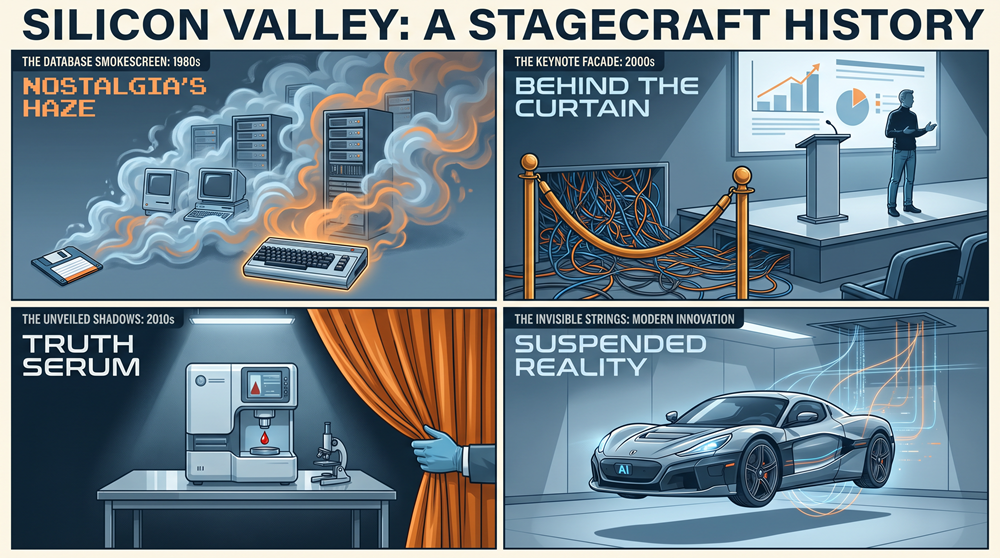
The Silicon Valley Pedigree of “Fake It Before You Make It”
To understand how we arrived at a remote-controlled sports car jumping over a line of vehicles on a closed stage, we have to look at the historical pedigree of the “Fake It Before You Make It” strategy in technology. For forty years, tech titans have used illusion as a competitive weapon to freeze out rivals and secure funding.
In the late 1970s and 1980s, Larry Ellison turned this practice into an art form at Oracle. First, noticing that no customer wanted to take a risk on a Version 1.0 product, Ellison famously skipped Version 1 altogether and launched Oracle’s initial relational database as “Version 2.” More aggressively, Oracle’s sales force routinely sold features and software architectures that existed only on whiteboards, using mocked-up demonstrations to convince enterprise buyers that the code was ready. This practice – which helped give rise to the industry term “vaporware” – worked for Ellison because software is malleable. Once the contracts were signed, Oracle’s programmers worked grueling hours to write the code before the customer’s implementation window closed. Because early database bugs didn’t physically kill anyone, Ellison got away with it and built an empire.
Steve Jobs elevated the staged demonstration into high theater, both during his exile at NeXT and upon his triumphant return to Apple. When Jobs unveiled the NeXT Computer in 1988, the hardware and the NeXTSTEP operating system were nowhere near production-ready. The demo paths were rigidly scripted; engineers held their breath backstage, knowing that if Jobs clicked a single icon out of sequence, the entire machine would crash. Yet the illusion was so seamless that the audience believed they were looking at a finished workstation. Nearly two decades later, during the legendary 2007 iPhone keynote, Jobs pulled off an even riskier sleight of hand. The prototype iPhones on stage were so unstable that they couldn’t play an entire audio or video clip without crashing, and the cellular radio kept dropping connections. Apple’s engineers had to hard-code the phone’s signal indicator to always display five full bars and created a “golden path” script where Jobs seamlessly swapped between multiple pre-staged devices hidden behind his podium before any single unit’s memory could leak and crash.
However, the dark side of idolizing Jobs and Ellison culminated in the spectacular fraud of Elizabeth Holmes at Theranos, a saga thoroughly documented by CNET and Inc. Magazine. Holmes explicitly modeled herself after Jobs, adopting his black turtleneck uniform, and absorbed the Silicon Valley gospel that if you project absolute certainty, your scientists will eventually figure out how to make the product work. When her miniature “Edison” blood-testing devices failed to produce accurate results, she faked the demos for investors and retail partners like Walgreens – routing samples to modified, commercially available Siemens machines hidden in a back room while showing pre-recorded results on the Edison’s screen. Holmes failed to grasp a fundamental rule: you can fake a software user interface, and you can script a smartphone keynote, but you cannot fake biological physics or clinical pathology without destroying human lives.
The Escalating Dangers of Premature Finish
When executives present early-stage proofs-of-concept as mature, nearly finished solutions, the consequences reverberate far beyond a single company’s balance sheet.
First, it creates profound market distortion. By announcing a product with impossible specifications years before it is viable, a dominant player freezes capital allocation across the entire sector. Venture capitalists stop funding legitimate, incremental competitors because they believe the market leader has already solved the problem. Customers delay purchasing actual, available vehicles or enterprise tools, waiting instead for the promised miracle machine.
Second, it extracts interest-free loans from the public under questionable pretenses. In Tesla’s case, prospective buyers were asked to put down $50,000 – and in the case of the “Founders Series,” a full $250,000 upfront wire transfer – starting back in 2017 for a vehicle promised for 2020. Holding hundreds of millions of dollars in customer deposits for nearly a decade while continuously moving the goalposts erodes consumer trust across the entire automotive industry.
Finally, there is the safety hazard of psychological over-trust. We have already seen this play out with Tesla’s branding of “Autopilot” and “Full Self-Driving.” When a company uses theatrical demonstrations to convince the public that its technology possesses near-magical capabilities, everyday drivers inevitably test those limits on public highways, often with fatal results.
Pulling Back the Curtain on the “Flying” Tesla Roadster
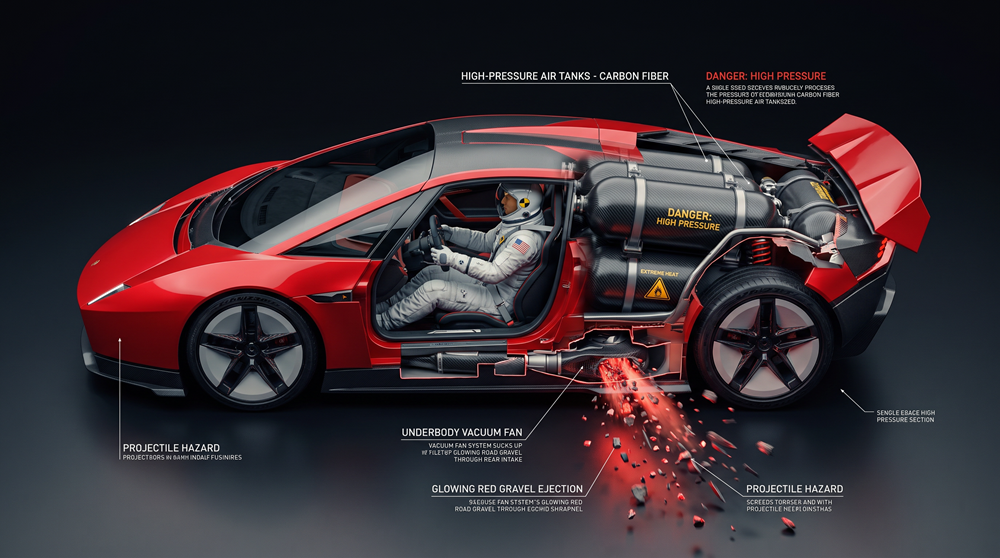
That brings us to the latest showcase of the second-generation Tesla Roadster, detailed in reports by Space.com and The Economic Times. On the surface, the spectacle was pure science fiction brought to life: a sleek sports car accelerating from 0 to 60 mph in a claimed 0.81 seconds, using downward-firing thrusters to leap cleanly over six parked vehicles (including a Tesla Semi cab), and driving up a curved ramp to cling upside-down to a ceiling.
The Economic Times
To the casual observer on social media, it looked like Elon Musk had finally built a flying, gravity-defying production car. However, when you examine what was concealed or downplayed during the presentation, the illusion unravels quickly:
- There was no human in the car: During the airborne jumps and inverted ceiling runs, no human test driver was permitted inside the cabin. Instead, the seat was occupied by a mannequin dressed in a SpaceX suit – a callback to “Starman”. The vehicle was operated entirely by remote control or pre-programmed telemetry because the risk of catastrophic structural or control failure was far too high for a human occupant.
- It isn’t actually a passenger car anymore: To make the car “fly” for even a couple of seconds, engineers had to install 10 cold-gas thrusters fed by massive Composite Overwrapped Pressure Vessels (COPVs) holding roughly 600 liters – about 250 kilograms (550 pounds) – of highly pressurized air. As Tesla’s own engineering team admitted, those tanks fill “every usable void in the car”. Consequently, the originally promised four-seat grand tourer with cargo space for weekend luggage has been gutted into a cramped single-seater just to house the air tanks.
- It is a five-second party trick: As analyzed by the Hindustan Times, cold-gas propulsion systems have a notoriously low specific impulse (around 65 to 70 seconds in vacuum, and even less at sea level). Lifting a multi-ton electric vehicle consumes that stored compressed air almost instantaneously. Once you do one brief hop, the tanks are depleted, and an onboard electric compressor must run off the main drive battery to slowly repressurize the vessels – draining the car’s driving range in the process.
The Economic Times
- The street-legality bait-and-switch: While the stunt was used to hype Roadster reservations, the fine print reveals that the Roadster line has been fractured into tiers – Performance, Thrust, and Rocket. The full thruster-equipped “Rocket” version shown jumping on stage will never be street-legal, nor will it pass standard federal crash-safety homologation.
Why Vacuum Cornering and Air Boosters Fail in the Real World
Beyond the theatrical omissions, we must examine why neither of the Roadster’s headline technologies – vacuum-assisted ground effects and high-pressure air thrusters – makes an ounce of practical sense for a safe, affordable road car.
To stick to the ceiling and achieve violent cornering speeds, Tesla adopted a multi-mode underbody fan and ground-sealing system that pulls air from beneath the chassis to create an artificial vacuum. This is not a Tesla invention; it was pioneered in Formula One by Gordon Murray’s infamous 1978 Brabham BT46B “fan car” and perfected in the modern era by the British track-only hypercar, the McMurtry Spéirling PURE (also detailed on Wikipedia), which uses twin 23,000-rpm fans to generate up to 2,000 kg of downforce from a standstill.
There is a fundamental reason why Formula One banned the Brabham fan car after a single race, and why McMurtry restricts the Spéirling to pristine race tracks: public roads are dirty and uneven.
First, a vacuum fan system relies on flexible skirts sealing the underside of the car against a smooth surface. On a public highway, that system becomes an industrial-strength street sweeper that ingests gravel, loose asphalt, broken glass, and road debris, then blasts it backward out the exhaust diffusers at over 150 mph. In everyday traffic, a vacuum car would act like a claymore mine, shattering the windshields of every vehicle behind it and maiming pedestrians or cyclists.
Second, vacuum downforce suffers from a terrifying aerodynamic flaw: sudden stall. If you are pulling 3Gs around a highway mountain curve relying on underbody suction, and your car hits a pothole, a mid-corner expansion joint, or a crown in the road, the skirt seal breaks instantly. Your downforce drops from 4,000 pounds to zero in a millisecond. No human driver has the reflexes to catch a car when its mechanical grip vanishes mid-corner; the vehicle will instantly spin off the road and into a guardrail or oncoming traffic.
The cold-gas air boosters are equally nonsensical for public roads. Wrapping a passenger compartment in carbon-fiber tanks pressurized to 5,000 to 10,000 PSI means that in the event of a high-speed T-bone collision with a heavy SUV, you aren’t just dealing with lithium-ion battery fire risks – you are sitting inside a potential pneumatic bomb. Furthermore, firing high-decibel supersonic jets of compressed gas on city streets would rupture the eardrums of nearby pedestrians and blow small motorcycles out (and some cars) of adjacent lanes.
When you combine a sub-one-second 0-to-60 acceleration time with active rocket thrusters, explosive pressure vessels, and a vacuum system that turns road gravel into shrapnel, the vehicle becomes completely uninsurable. Automotive insurance underwriters base their actuarial tables on predictable kinetic risk and repairability. No standard casualty insurer would ever write a policy for a vehicle capable of launching itself into the air or firing high-pressure gas jets in a crowded parking lot – the third-party liability exposure alone would run into the tens of millions of dollars per incident. Even specialty Lloyd’s of London syndicates would restrict such a vehicle to closed-course, unmanned demonstrations, effectively rendering it a multi-million-dollar paperweight for regular buyers.
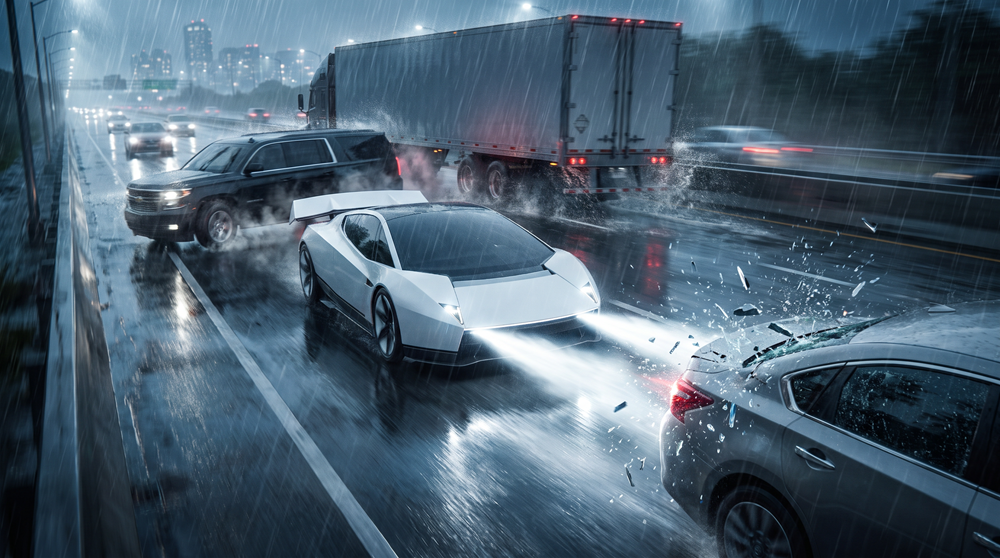
The Emergency Braking Pivot—And Its Fatal Flaw
As an industry analyst, I always look for whether an extreme prototype technology can be scaled back into a practical, life-saving feature. Could a much more limited version of cold-gas booster technology be used not for stunts, but for active accident avoidance?
On paper, there is an intriguing engineering case for it. Standard automotive braking and stability control are entirely dependent on the coefficient of friction between four small rubber contact patches and the road surface. If a driver enters a blind corner way too fast, or suddenly hits a patch of black ice, standing water, or spilled oil, tire friction drops to near zero. Anti-lock brakes (ABS) and electronic stability control cannot save you if the tires have no grip to work with.
In that exact scenario, small, computer-controlled micro-thrusters mounted around the chassis could provide reaction control independent of tire traction – much like the maneuvering thrusters on a spacecraft. A short, automated burst of lateral thrust could counter a fatal oversteer slide on black ice and keep the vehicle in its lane. Similarly, forward-firing thrusters could drastically shorten stopping distances in an emergency panic-stop when a child runs into the street or traffic suddenly halts ahead.
However, the moment you game out how forward-firing emergency braking thrusters would actually function in real-world traffic, you run straight into two insurmountable physics and liability nightmares:
- The Front-End Blast Zone: Because Newton’s third law requires mass to be expelled forward to push the car backward, stopping a two-ton vehicle quickly requires firing a violent, concentrated blast of high-pressure gas directly out the front bumper. If you trigger that system to avoid rear-ending the car in front of you, that supersonic shockwave – along with every piece of sand, dirt, and road grit lying on the asphalt between the two vehicles – is blasted directly into the vehicle ahead. You might avoid bumper-to-bumper contact, only to sandblast the paint off the car in front, shatter its rear window, trigger its collision sensors, or literally blow a pedestrian or motorcyclist across the intersection.
- The Rear-End Pileup Guarantee: Even worse is what happens behind you. Modern traffic flow relies on shared deceleration limits; human drivers and automated radar cruise-control systems follow at distances calibrated for standard friction braking (roughly 0.8G to 1.1G of deceleration). If your thruster-equipped car suddenly uses pneumatic jets to stop on ice or wet pavement at 2.5Gs, the family minivan, pickup truck, or 80,000-pound semi-truck driving behind you cannot possibly match that deceleration rate. You will successfully avoid hitting the obstacle in front of you, only to guarantee that you are catastrophically crushed from behind by every vehicle following you. Instead of preventing an accident, the technology simply transfers the energy of the crash to your rear bumper while stripping the driver behind you of any chance to react.
Wrapping Up
Ultimately, the saga of the “flying” Tesla Roadster is a textbook cautionary tale of what happens when Silicon Valley’s “Fake It Before You Make It” culture collides with the unforgiving realities of automotive physics and public safety. While Larry Ellison and Steve Jobs used theatrical sleight of hand to buy time for software engineers to finish writing code, and Elizabeth Holmes proved that faking medical hardware leads to prison, Elon Musk’s latest demonstration attempts to sell laws-of-physics defiance as a consumer product roadmap. Stripping a car down to a remote-controlled single-seater stuffed with compressed air tanks and track-only vacuum fans makes for viral video clips and briefly buoys stock sentiment, but it is a dead end for practical, affordable, and insurable transportation. Until tech leaders stop treating stage illusions as substitutes for practical engineering, investors and consumers alike would be wise to keep their wallets closed and remember that when a demo looks too good to be true, it almost certainly is.

- Musk’s Flying Sportscar Showcases the Dangers Of ‘Fake It Before You Make It’ - October 27, 2026
- The Hidden Enterprise Goldmine in Bumble’s $1.3 Billion Take-Private Deal - October 19, 2026
- The One Job Silicon Valley Forgot to Invent: Why Every Enterprise Needs a Chief AI Consequence Officer (CACO) - October 13, 2026