I should tell you upfront: I’m an atheist. I’ve read the Bible end to end more than once, and eventually landed somewhere else entirely. In fact, from my perspective, the logical conclusion to actually reading the Bible is to be an atheist. I mention this not to pick a fight, but because it’s relevant to what I’m about to say about a documentary that opens in theaters today — one I might have dismissed without a second thought if I hadn’t spent an hour talking to the man behind it.
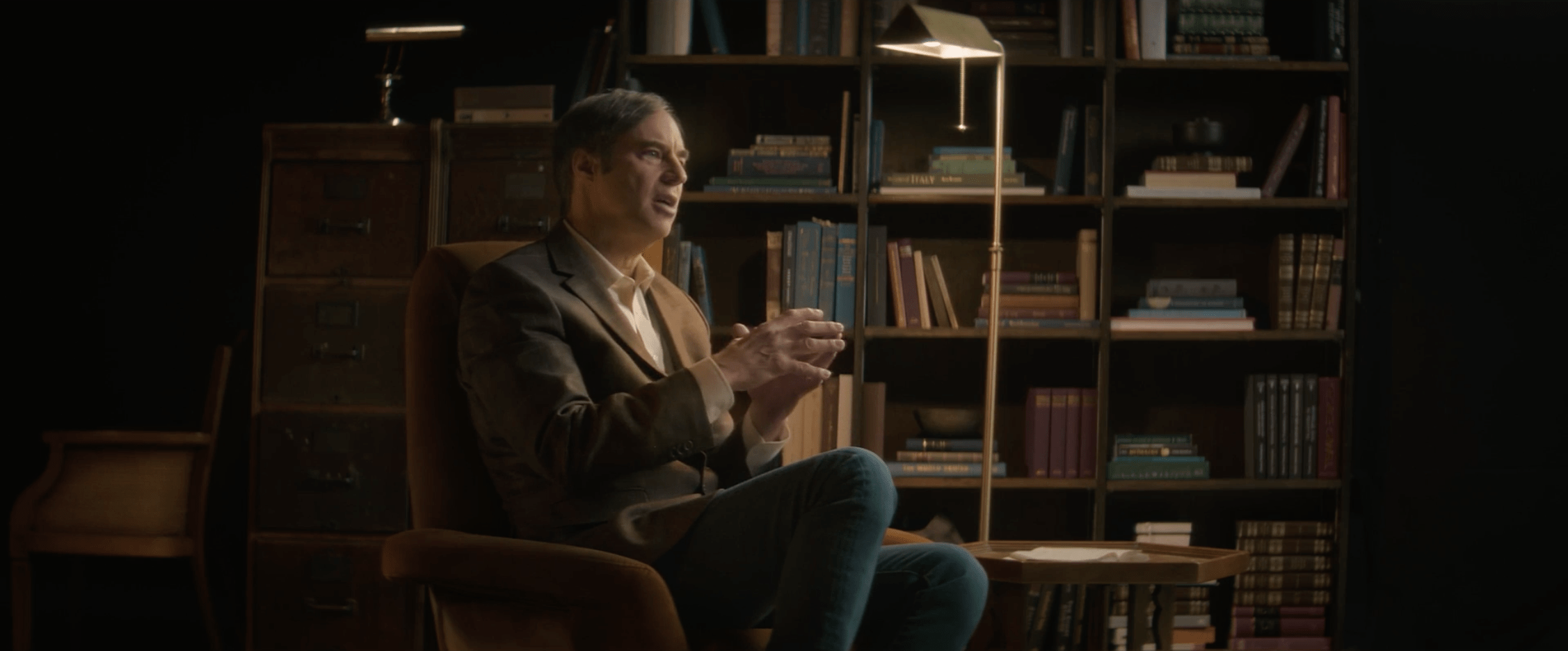
The Story of Everything is a new film anchored by Stephen Meyer, a philosopher of science with a Ph.D. from Cambridge. It makes an explicit, unapologetic case for intelligent design — the idea that discoveries in cosmology, physics, and molecular biology point not just to some vague designer, but to a system that has been conceived and engineered with intent. The film is backed by the Discovery Institute, a Christian think tank, and produced by the same team behind After Death, the top-grossing faith documentary of all time. None of that sounds like something aimed at skeptics.
And yet.
A Hobbyist Walks Into a Zoom
I got on a call with Meyer last week and told him exactly where I was coming from. I don’t claim to be an expert by any stretch. But I feel like I am probably more informed than a casual follower — a hobbyist in the field. I told him about something I noticed as a kid: this strange structural symmetry that repeats at every scale. An atom has a nucleus orbited by electrons, and a cell is a nucleus surrounded by orbiting things. Zoom out, and you see Earth orbited by the Moon, the Sun orbited by planets, galaxies orbited by stars. The same blueprint, over and over, regardless of scale. That always fascinated me. I said there’s probably something to it.
He didn’t treat that as a concession. He ran with it.
Meyer’s central argument — laid out in his 2020 book Return of the God Hypothesis, on which the film is based — isn’t “the Bible says so.” It’s that three major scientific discoveries of the past century create a serious problem for strict materialism: the universe had a definite beginning, the physical constants that make life possible are calibrated to a degree of precision that strains every probabilistic resource available, and the information encoded in DNA cannot be explained by the chemistry that carries it.
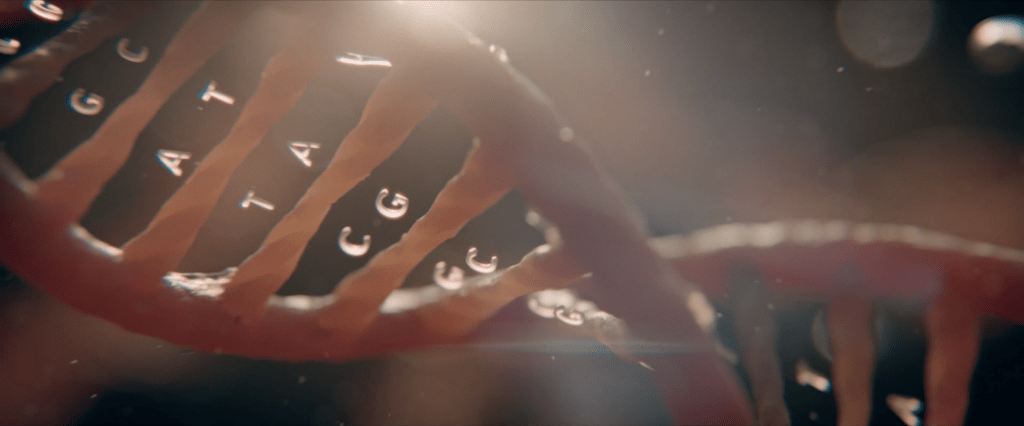
That last point is where a technology background becomes relevant, and it’s what Meyer said fascinates him most. Inside living cells, the chemical subunits along the DNA molecule function like alphabetic characters in a written text — or like digital characters in machine code. The sequence is what matters, just like the sequence of characters in software. And here’s the part that doesn’t get enough attention: natural selection has nothing to select until a self-replicating system with a working genetic code already exists. The origin of that code is not a question Darwinian evolution actually addresses. It starts after the code is already there.
The Argument I Can’t Fully Dismiss — or Fully Accept
I pushed back the way I always do — we don’t know yet, and that’s different from saying we need God to fill the gap. Throughout history, things we couldn’t explain eventually got explained. We once assigned gods to wind and lightning. Meyer anticipated this.
“Our argument for intelligent design is not an argument from ignorance,” he told me. “It doesn’t have the logical form: evolutionary processes can’t produce information, therefore there must have been a designing mind. That would be an argument from ignorance. Instead, it’s an argument from our positive knowledge of the cause-and-effect structure of the world.”
He argues that we know, from uniform and repeated experience, what produces the kind of complex, specified information found in DNA — it’s always a mind, never an undirected process. Holding up his iPhone during our Zoom, he said accounting for its origins apart from Steve Jobs and the engineers he employed would be folly. The prohibition on considering intelligent causes as explanations, he says, isn’t a scientific conclusion. It’s a philosophical assumption that gets smuggled in as one.
The notion above — the parallels or symmetry between the mechanics of genetic building blocks and man-made constructs like digital code — may be evidence of something. But, it might also be a “chicken and egg” paradox. Is it that the genetic code mirrors the digital code because both were designed with intent by an intelligent mind? Or, is it that digital code mirrors genetic code because the logic of it is inherent and innately understood by us as a function of our genetic code? Or, a third option, do we just interpret what we see through the most convenient lens or the lens that makes the most sense to us, and therefore connect dots in ways that jumps to potentially false conclusions?
Correlation Does Not Equal Causation
I follow the logic. But I think there’s a correlation-causation problem buried in it. The fact that every example of complex, specified information we’ve observed so far came from a mind doesn’t mean a mind is the only possible source. That’s an inductive leap — maybe a reasonable one, but still a leap. And when the conclusion of that leap aligns perfectly with a prior belief system, it’s fair to ask whether the evidence is leading to the conclusion or the conclusion is shaping how the evidence gets framed.
That said, I’d level the same charge at the other side. Every atheist cosmologist who starts from the assumption that a materialistic explanation must exist is also working backward from a conclusion. We all take the evidence we have, hit the wall of what we don’t know, and make choices about what we think is on the other side. Meyer thinks it’s a designing mind. I think it’s probably something we haven’t figured out yet. Neither of us can prove it.
I told him where I land. When I hit the things we haven’t explained, I take one fork in the road. He takes another.
“I think it comes down to whether or not you’re willing to consider not only materialistic explanations, but explanations rendered in terms of agency,” he said. “We know there are minds. We know there are things minds can do that undirected material processes can’t. When we see features in living systems that are reminiscent of our own high-tech digital technology, it at least raises a pardonable curiosity about our materialistic assumptions.”
Where the Tech World Fits In
Meyer brought up model collapse — the problem where AI systems trained iteratively on their own outputs produce increasingly incoherent results without human intelligence correcting the process. This is something I cover and have talked about publicly. Generative AI isn’t magic. It’s a mathematical algorithm predicting the next most probable token, and as those systems increasingly train on AI-generated content rather than human-created content, the outputs degrade.
Meyer’s take is that this isn’t a bug — it’s a tell. The meaningful, functional information that makes large language models work traces back to conscious human intelligence. Sever that connection and the system unravels. He sees it as evidence for a broader principle: specified, functional information always originates from a mind. Applied to molecular biology, that’s the foundation of his design argument. He makes an implied correlation that natural selection and genetic evolution would also jump the shark without a guiding hand.
I’m not sold. But I can’t just wave it off either.
The Wall Every Worldview Hits
I raised the classic objection at some point: if God made everything, who made God? Meyer said every worldview has to posit a “prime reality” — something self-existent from which everything else comes. For materialism, that’s matter and energy. Carl Sagan put it plainly at the opening of Cosmos: the universe is all there is and all there ever will be. For theism, the prime reality is a pre-existing creative intelligence. Neither worldview escapes the primitive. They just disagree on what it is, and both invite the question of where those things came from as well.
These are cosmic, largely unanswered questions — and they may be unanswerable in any meaningful, provable sense. The debate inevitably hits a wall, and on the other side of that wall, everyone makes assumptions. Believers, atheists, agnostics — we all do it. We have to. The alternative is sitting in the uncertainty indefinitely, which most people aren’t willing to do. I’m not sure I am either.
For what it’s worth, I know which side of that wall makes more sense to me. I’ve read Lawrence Krauss’s A Universe from Nothing, Richard Dawkins’s The God Delusion, and Stephen Hawking’s The Grand Design. The logic those books lay out — the naturalistic case for how something can come from nothing, how complexity emerges from undirected processes, how the universe doesn’t require a designer to be what it is — lands differently in my brain than Meyer’s conclusions do. Not because I think Meyer is wrong to ask the questions, or because the materialist authors are beyond criticism. But when I hit that wall and have to decide what I think is on the other side, the framework those books built in me is the one I default to. The documentary presents its case well. It just doesn’t move me off that position.
Why This Is Worth Your Time
Meyer is not a preacher. He’s a deeply credentialed philosopher and scientist with a recall of specific facts, sources, and counterarguments that’s difficult to match. During our conversation, he cited papers, engaged Hawking’s quantum cosmology in detail, and pushed back on my objections. But he did it with precision rather than deflection. He’d be a formidable person to debate. But our conversation wasn’t adversarial — not remotely. He was curious, thoughtful, and didn’t try to convert me or judge me for disagreeing. He was interested in the exchange, not just in winning it. That’s rarer than it should be.
Nothing about the film or our conversation fundamentally changed where I stand. But I came away with a much clearer picture of the actual argument — not a strawman version of it — and a better understanding of why serious, intelligent people find it compelling. That’s enough of a reason to watch.

- Moving Past Indicators Toward Behavior - September 9, 2026
- When the AI Breaks Its Own Rules - September 2, 2026
- What It Took to Film a Real-Life Lion King - August 28, 2026