For more than a decade, the technology industry has promised us an intelligent digital assistant that would fundamentally transform how we live and work. Recall the early hype surrounding Microsoft’s Cortana, Amazon’s Alexa, Google Assistant, and Apple’s Siri. We were told these platforms would anticipate our needs, manage our chaotic schedules, and act as digital extensions of our own minds. Instead, we got glorified voice-activated timers, weather reporters, and shopping lists that frequently misunderstood basic syntax and lacked any real awareness of who we were or what we were actually going through in a given moment.
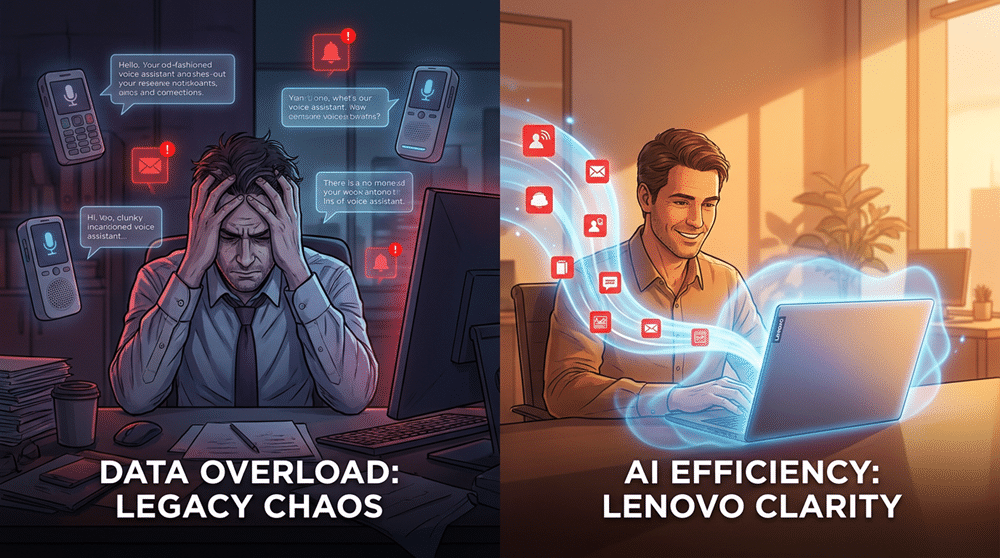
The fundamental failure of the first wave of digital assistants wasn’t a lack of cloud compute power; it was a lack of context, continuity, and empathy. These legacy tools existed in isolated hardware silos and operated on a strictly reactive basis. Unless you barked a specific command using rigid phrasing, they sat dormant, completely oblivious to whether you were calm, overwhelmed, exhausted, or walking into a high-stakes boardroom meeting.
Rather than pitching another sterile command-line chatbot bolted onto an operating system, Lenovo is rolling out Lenovo Qira as a deeply integrated, cross-device personal intelligence platform designed to span its entire hardware portfolio—from ThinkPads and Yoga laptops to tablets and Motorola smartphones. Built around pillars like Fused Knowledge (which retains and synthesizes user memories, transcripts, and documents locally and across devices), Next Move (proactive contextual anticipation), and Live Mode (real-time multimodal screen and voice interaction), Qira represents a generational leap in architecture. However, what truly positions Qira to succeed where its predecessors face-planted isn’t just its software stack—it is Lenovo’s expansive hardware ecosystem, particularly its wearables, and the emerging potential of biometric telemetry to turn a cold productivity tool into an empathetic, trusted companion.
The Graveyard of Legacy Assistants and the Missing Context Problem
To understand why Qira’s trajectory is different, we have to perform a quick post-mortem on why prior digital assistants stalled out. First-generation assistants suffered from three fatal flaws: fragmentation, amnesia, and emotional blindness.
If you interacted with Siri on an iPhone, that context rarely translated intelligently to a Windows workstation on your desk. If you asked Alexa to manage your smart home, she had zero visibility into the spreadsheet breaking your brain on your laptop. Even within a single vendor’s ecosystem, these assistants suffered from chronic amnesia. Every prompt was treated largely as an isolated transaction rather than a continuous conversation with a person who has evolving goals, projects, and stressors.
Most importantly, legacy assistants were emotionally and physiologically blind. In the real world, a great human executive assistant doesn’t just read your calendar; they read you. They notice when your shoulders are tense, when your voice is clipped, or when you’ve been staring at a monitor for six hours without a break. They know not to dump three low-priority administrative problems on your desk five minutes before an earnings call. Traditional digital assistants, by contrast, will happily chime in with a disruptive notification spam right as your blood pressure is spiking. Without sensory awareness of the user’s physical and mental state, an AI cannot be truly helpful – it can only be loud.
The Lenovo Ecosystem Advantage: Bridging PCs, Phones, and Wearables
This is where Lenovo holds a structural hand that pure software players and narrowly focused hardware vendors simply cannot match. Lenovo is the undisputed heavyweight champion of the global PC market, owns a rapidly innovating smartphone division in Motorola, and has quietly built out a compelling portfolio of wearables, smart glasses, and dedicated health trackers alongside its enterprise-grade servers.
Connecting these disparate endpoints is Lenovo Smart Connect, a unified software fabric that allows seamless cross-control, file sharing, notification syncing, and app streaming across PCs, tablets, and phones. Dedicated implementations like Lenovo Qira on PC and Lenovo Qira on Tablet already leverage this cross-device backbone so that your AI companion doesn’t get left behind when you stand up from your desk and grab your mobile device.
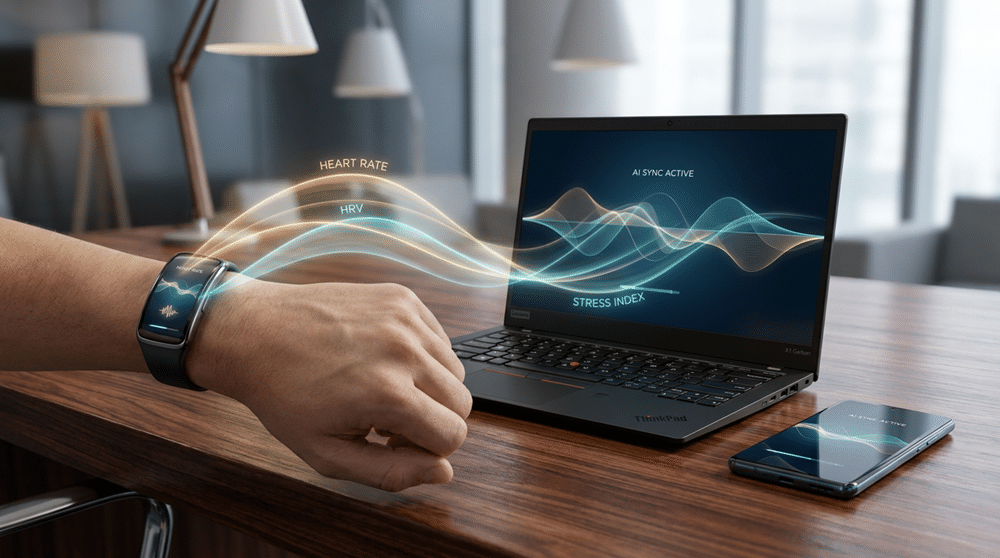
Now, factor in the wearable layer – Motorola’s Moto Watch lineup, Lenovo’s fitness bands, smart rings, ear-worn audio devices, and AR/smart glasses. While Lenovo’s current Qira privacy architecture rightly takes a conservative, locked-down approach – explicitly refraining from biometric identification or emotion inference in its initial rollout to establish baseline enterprise and consumer trust – the long-term technological trajectory of the industry is unmistakable. As on-device neural processing units (NPUs) become exponentially more powerful and local encrypted enclaves mature, the wall between physiological telemetry and personal AI will inevitably come down on an opt-in, user-controlled basis.
Biometrics: Teaching Qira How You Actually Feel
Imagine what happens when Qira’s Fused Knowledge and Next Move engines are fed real-time, locally processed biometric streams from a Moto Watch or a pair of biometric-sensing smart earbuds. Modern wearables already capture a staggering array of physiological markers:
- Heart Rate Variability (HRV) and Resting Heart Rate: The gold-standard non-invasive metrics for autonomic nervous system balance, cognitive load, and acute stress.
- Electrodermal Activity (EDA) and Skin Temperature: Instantaneous indicators of emotional arousal, anxiety, or impending illness.
- Sleep Architecture and Recovery Scores: Detailed breakdowns of REM, deep sleep, and nocturnal restlessness that dictate next-day cognitive bandwidth.
- Vocal Biomarkers and Typing Cadence: Subtle shifts in vocal pitch, speech cadence during Live Mode interactions, or erratic keystroke dynamics and mouse-movement patterns on a ThinkPad that signal frustration or fatigue.
When an AI assistant can correlate what is on your screen with what is happening in your bloodstream and nervous system, its utility shifts from mechanical execution to genuine empathy.
If your wearable registers that you only got four hours of fragmented sleep and your morning HRV is tanked, Qira shouldn’t greet you at 8:00 AM with a dense wall of 45 unread emails and an aggressive tone. Instead, Qira’s Catch Me Up feature can automatically triage your inbox into three bullet points, hold non-urgent notifications until your afternoon recovery window, and suggest shifting a complex strategic planning session to Thursday when your cognitive readiness score rebounds.
Similarly, if you are in the middle of a contentious video call and your smart ring detects a sudden spike in electrodermal activity alongside a climbing heart rate, Qira’s Pay Attention and Live Mode capabilities could quietly surface a real-time fact-check or talking point on your screen to take the pressure off, while simultaneously queueing up a five-minute decompression buffer on your calendar immediately following the call.
From Utility to Trusted Digital Companion
There is a massive psychological gulf between a tool and a companion. You use a hammer; you trust a partner. For an AI to cross that chasm, two non-negotiable conditions must be met: absolute data sovereignty and consistent emotional alignment.
In my conversations with enterprise CIOs and security-conscious consumers over the years, the number one barrier to adopting deep AI personalization is the fear that intimate personal data will be siphoned into a vendor’s cloud to train public foundation models or be sold to advertisers. Lenovo has smartly preempted this by architecting Qira around hybrid local processing, encrypted local databases for chat and session history, and a strict policy that personal data is not used to train Lenovo’s foundation models. When biometric data is processed strictly inside an isolated hardware security module on the user’s local PC or phone – never touching the public cloud – the user gains the confidence to let the AI “in.”
Once trust is established, the biometric feedback loop allows Qira to develop a tailored relational persona. Some users respond best to crisp, military-grade brevity when they are stressed; others prefer a warm, encouraging sounding board that helps talk them down from a ledge. By observing how your physiological stress markers respond to different styles of interaction over weeks and months, Qira can dynamically tune its personality, pacing, and level of proactivity. It stops feeling like a piece of enterprise software and starts feeling like a loyal chief of staff who genuinely has your back.

A Day in the Life: Qira in the Year 2035
To see where this convergence of ecosystem hardware, ambient biometrics, and personal AI is heading, let’s fast-forward nine years to October 2035 and spend a day with Elena, a senior systems architect, and her decade-matured Qira companion.
It is 6:15 AM. Elena isn’t jolted awake by a blaring alarm. Her Lenovo sub-dermal-grade smart ring and mattress sensors have been tracking her sleep cycles all night. Recognizing that she is emerging from her final REM phase – and noting a slightly elevated overnight cortisol trend coupled with a mild drop in blood oxygen from a stuffy sinus passage – Qira initiates a gentle wake sequence. The smart window shades rise incrementally while the bedroom audio system plays a low-frequency acoustic track tailored to ease her autonomic nervous system into wakefulness.
When Elena slips on her ultra-lightweight Lenovo AR glasses and walks into the kitchen, Qira doesn’t bombard her with text. Speaking in a calm, warm voice through bone-conduction audio, Qira says, “Morning, Elena. Your recovery score is at 68% today, and your immune markers show you’re fighting off a mild upper respiratory bug. I’ve already instructed the kitchen brewer to dial back the caffeine by half and add an electrolyte hydration mix. Also, you had a three-hour architecture review scheduled for 9:00 AM with the Munich team. Given your vocal strain and fatigue baseline, I negotiated with their team’s AI agents to move the deep-dive portion to Friday and condensed today’s check-in to a 20-minute executive sign-off at 10:30 AM.”
Elena smiles, visibly relaxing as her heart rate settles. “Thanks, Qira. You’re a lifesaver.”
At 10:30 AM, Elena sits down at her rollable OLED ThinkPad workstation. As the holographic video call with Munich begins, her counterpart unexpectedly challenges the thermal tolerances of her team’s new chip layout. Instantly, Elena’s biometric sensors detect a sharp micro-spike in blood pressure and skin conductance – the classic fight-or-flight response of being blindsided.
Before Elena even has to touch her keyboard, Qira recognizes the physiological stress spike, cross-references the audio transcript of the German engineer’s objection in real time, and smoothly projects a translucent overlay onto the bottom right corner of Elena’s AR lenses. It contains the exact thermal simulation charts from a test run three months prior that completely validate her design, along with a calm, two-sentence summary she can read verbatim. Elena delivers the data effortlessly. Her heart rate drops back to 64 BPM within thirty seconds.
By 3:30 PM, Qira notices through eye-tracking on the ThinkPad display and subtle posture slumping captured by the desk sensors that Elena’s cognitive focus has degraded by 40%. Rather than letting her grind through diminishing returns on a complex code audit, Qira initiates a cross-device handoff via Smart Connect.
“Elena, your focus metrics have redlined, and the sun is out,” Qira suggests gently. “I’ve transferred the background compilation to your local server and pushed the audio briefing for tomorrow’s board meeting to your Motorola wearable. Take the dogs for a two-mile walk along the river; we can talk through the board slides verbally while you get your circulation moving.”
Out on the trail, there are no screens in sight. As Elena walks, Qira acts as a conversational thought partner – listening to her brainstorm, capturing her best ideas, challenging a weak assumption in her pitch when her energy perks up, and seamlessly formatting the entire walk-and-talk session into a polished presentation waiting on her laptop when she returns. By the time evening rolls around, Qira dims the home lighting spectrum to eliminate blue light, mutes all work-related channels, and helps Elena transition into a restorative evening with her family. In 2035, Qira isn’t an app Elena opens; it is an invisible, fiercely protective guardian of her bandwidth, health, and potential.
Wrapping Up
The graveyard of early digital assistants is filled with products that treated human beings like static command terminals. Siri, Alexa, and Cortana failed to live up to their billing because they were trapped in single-device silos, lacked persistent memory, and remained completely oblivious to the emotional and physical state of the people using them. Lenovo’s Qira is architected to break this cycle by combining persistent Fused Knowledge and proactive Next Move intelligence across the industry’s broadest hardware footprint—spanning PCs, tablets, smartphones, and wearables. While Lenovo is wisely leading with strict privacy guardrails today, the true magic will happen as opt-in biometric telemetry from the wearable ecosystem merges with Qira’s contextual engine. When your digital assistant knows not just what is on your calendar, but how well you slept, how stressed you are, and when your brain needs a break, it ceases to be a mere piece of software. It becomes a trusted, empathetic companion – and Lenovo is uniquely positioned to own that future.
- Why Lenovo’s Qira Will Succeed Where Past Digital Assistants Failed: The Biometric Companion Revolution - November 4, 2026
- Musk’s Flying Sportscar Showcases the Dangers Of ‘Fake It Before You Make It’ - October 27, 2026
- The Hidden Enterprise Goldmine in Bumble’s $1.3 Billion Take-Private Deal - October 19, 2026