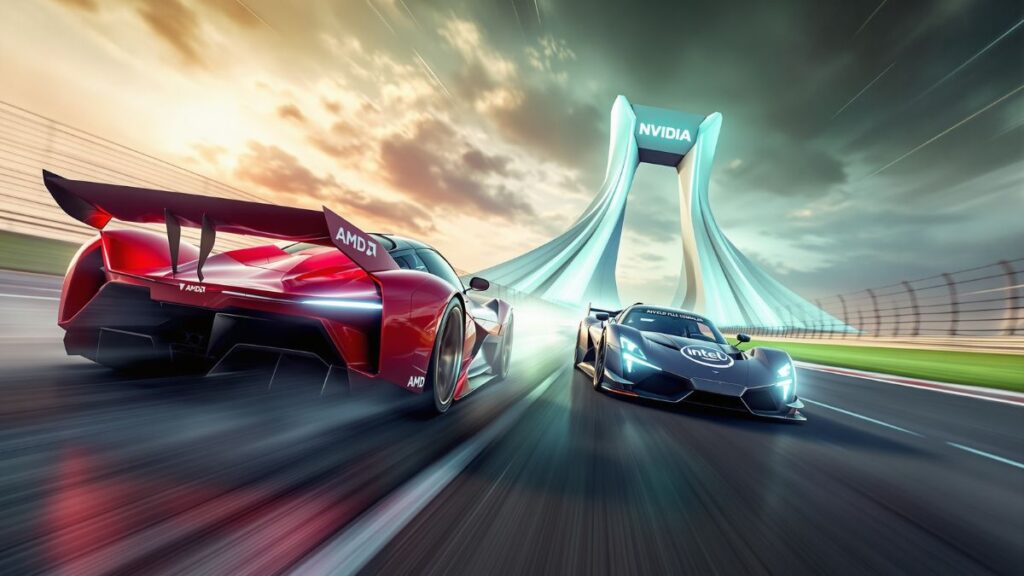
The semiconductor market is currently a tale of two titans, but one is largely flying under the radar while delivering explosive, calculated growth. NVIDIA, having reached the historic peak of a multi-trillion-dollar valuation, faces the immense pressure of living up to that hyper-valuation. Meanwhile, AMD, led by a management team praised for its focused execution, is quietly delivering record revenue of $9.2 billion, up 36% year-over-year (YOY), comfortably surpassing analyst consensus estimates. This isn’t just a strong quarter; it’s a strategic masterclass in how to win the AI infrastructure war by focusing on execution, diversification, and meeting customer needs rather than chasing stock market distractions.
This performance suggests that while NVIDIA is currently the most valuable company, AMD may be the better long-term value. This isn’t just about AMD being undervalued; it’s about NVIDIA being dangerously overvalued, creating a set of strategic weaknesses that AMD is perfectly positioned to exploit.
The Trillion-Dollar Distraction & Internal Disparity
NVIDIA’s success is historic. But a multi-trillion-dollar valuation is a burden, not just a trophy. It breeds arrogance. We see this in the company’s reliance on its proprietary CUDA software, a powerful but walled garden that creates deep vendor lock-in. This strategy, while brilliant for a time, has made its customers desperate for an alternative.
A colossal valuation also becomes a massive distraction. Executives must now spend an inordinate amount of time managing Wall Street’s astronomical expectations, forcing a focus on maintaining high double-digit margins rather than on customer-centric flexibility. This focus on short-term stock performance over long-term partnership is NVIDIA’s core vulnerability.
Furthermore, this meteoric stock rise creates a severe internal cultural challenge: wealth disparity. The company is now composed of two classes: the long-term veterans whose stock options have made them multi-millionaires, and the new hires who missed the rocket ship and are being paid (relatively) normal salaries. This “stock option lottery” creates a toxic mix of “golden handcuffs” (employees who are coasting to their next vesting date) and resentment from new talent, inevitably degrading the very focus and execution that led to the success in the first place.
The Customer-Centric Contender (AMD’s IBM DNA)
This is where AMD’s opening lies. The company’s leadership, forged in the enterprise-focused culture of IBM, understands the value of partnership over pricing power. CEO Dr. Lisa Su’s 13-year tenure at IBM wasn’t just a job; it was training in a “big iron” enterprise strategy. This approach, which values long-term stability, reliability, and listening to the customer, is a stark contrast to NVIDIA’s visionary-but-proprietary founder-led culture. While Jensen Huang is a brilliant pioneer, Dr. Su’s formal executive training may make her a more capable CEO for the long-term, sustainable enterprise marathon. Remember the old saying: the pioneers get the arrows; the settlers (in this case, AMD) get the land.
This is why companies prefer dealing with AMD. They’ve shown a willingness to build custom silicon for hyperscalers like Microsoft, offering flexibility rather than a rigid “take-it-or-leave-it” product map. This customer-centric focus, a direct result of its leadership’s IBM-forged DNA, is AMD’s most potent weapon against NVIDIA’s perceived arrogance. AMD doesn’t have the luxury of a $5 trillion valuation, so it retains its “strong number two” hunger and customer focus.
The Deployment Dilemma: Why AMD’s Hardware is Ready Now
AMD’s Q3 data center revenue hit a massive $4.3 billion (up 22% YOY), driven by 5th Gen EPYC processors and the Instinct MI350 Series GPUs. This is where the real fight is. While NVIDIA’s DGX platform, powered by the new Blackwell GPUs, is a technical marvel, it’s also a deployment nightmare.
Microsoft CEO Satya Nadella recently admitted the primary bottleneck for AI is no longer chips, but power. He bluntly stated, “…you may actually have a bunch of chips sitting in inventory that I can’t plug in. In fact, that is my problem today.” This is a direct reference to the massive power and liquid-cooling infrastructure required for next-gen NVIDIA hardware.
Meanwhile, AMD’s Instinct platform (not to be confused with its “Strix” client chips) is not just cheaper and offers more crucial memory (288GB of HBM3e) for running large models; it offers flexible, air-cooled options. It’s the powerful solution that customers can actually deploy into their existing data centers today.
And, on the client side, NVIDIA’s DGX Spark is far more expensive and underperforms AMD’s STRIX Halo; it isn’t even close.
The OpenAI “Side Door” Strategy
While NVIDIA has the high-profile direct deal with OpenAI, AMD has the smarter deal. Microsoft, OpenAI’s exclusive and essential cloud partner, is aggressively building out its Azure infrastructure using AMD’s Instinct MI300 and MI350 GPUs. This is a clear, strategic move by Microsoft to break NVIDIA’s monopoly, reduce its own costs, and secure a stable supply chain. AMD gets to be the indispensable “Plan B” that saves the entire industry from a single, high-cost supplier.
The Missing Trillion: AMD’s CMO Problem
If AMD’s tech and strategy are so good, why doesn’t its stock price reflect the same astronomical hype as NVIDIA’s? The answer is simple: Marketing.
AMD has long operated without a high-profile Chief Marketing Officer (CMO), and it shows. Its marketing is engineering-led (speeds, feeds, and benchmarks). NVIDIA’s marketing, by contrast, is brand-led. It built “GeForce” into a cultural icon and “CUDA” into an ecosystem that developers fear leaving.
This is where Lisa Su needs to pull a Lou Gerstner. When Gerstner famously saved IBM from collapse in the 1990s, he did it not just with operational cuts, but with a massive, unifying marketing pivot. He created the “e-business” campaign, a simple, powerful concept that repositioned IBM as the bedrock of the new internet economy.
AMD is at the same inflection point. It needs a world-class CMO who can build an ecosystem brand around its open-source ROCm platform. The message isn’t “we’re cheaper”; it’s “we are the open, flexible, and powerful enterprise standard.” With her IBM background, Lisa Su is uniquely positioned to understand this play. Her next great challenge is to empower a marketing chief to build a brand as powerful as AMD’s engineering.
Wrapping Up: The Quiet Giant’s Masterstroke
AMD’s stunning Q3 2025 financial report, delivering a record $9.2 billion in revenue, is a testament to flawless execution. While NVIDIA is forced to defend a valuation that has become a distraction, AMD is leveraging its IBM-trained leadership to focus on what matters: solving customer problems. It is relentlessly gaining share from Intel in the client market and has successfully positioned itself as the indispensable, open-source alternative to NVIDIA in the AI data center. AMD’s financial guidance is strong, its product roadmap is clear, and its customer-centric strategy is winning. If the company can finally solve its marketing problem and build a brand as powerful as its technology, its “undervalued” status will soon be a memory.

- Meta Finalizes Massive Teen Addiction Settlement, but Proposed App Restrictions Make Kids Less Safe - August 28, 2026
- The Aftermath of Corporate Overexpansion - August 25, 2026
- The 2026 Google Pixel 11 Pro Hits Thirty Hours of Battery Life but the New York Keynote Proved Google Wants You to Ignore It - August 21, 2026