For decades, the ritual of the “mobile professional” has remained unchanged: walk into a conference room, scout the perimeter for a power outlet, and sit as close to the wall as possible. We have lived in a state of tethered freedom, where the term “laptop” was always caveated by the reality that, under heavy load, your high-performance machine was little more than a ticking clock.
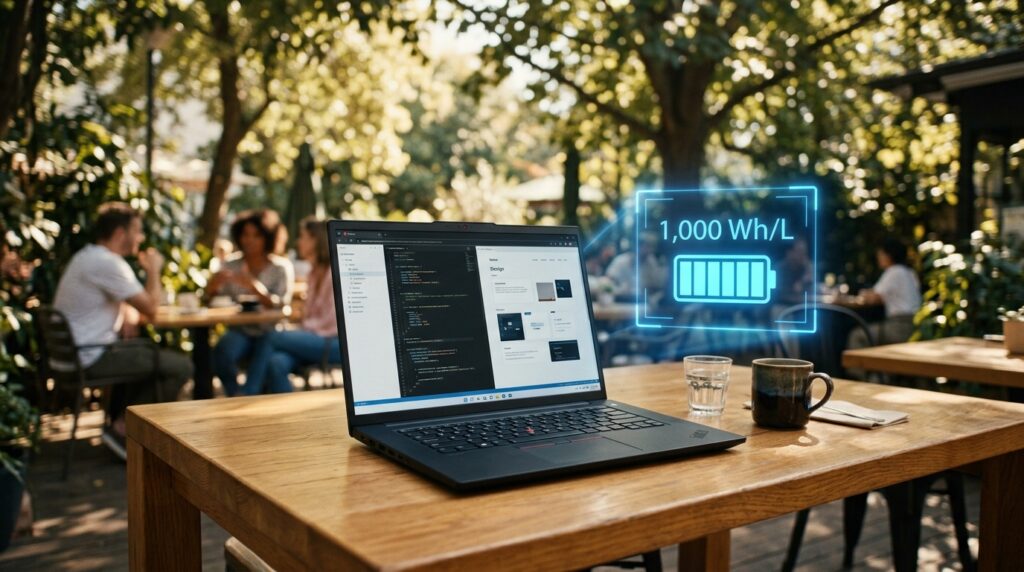
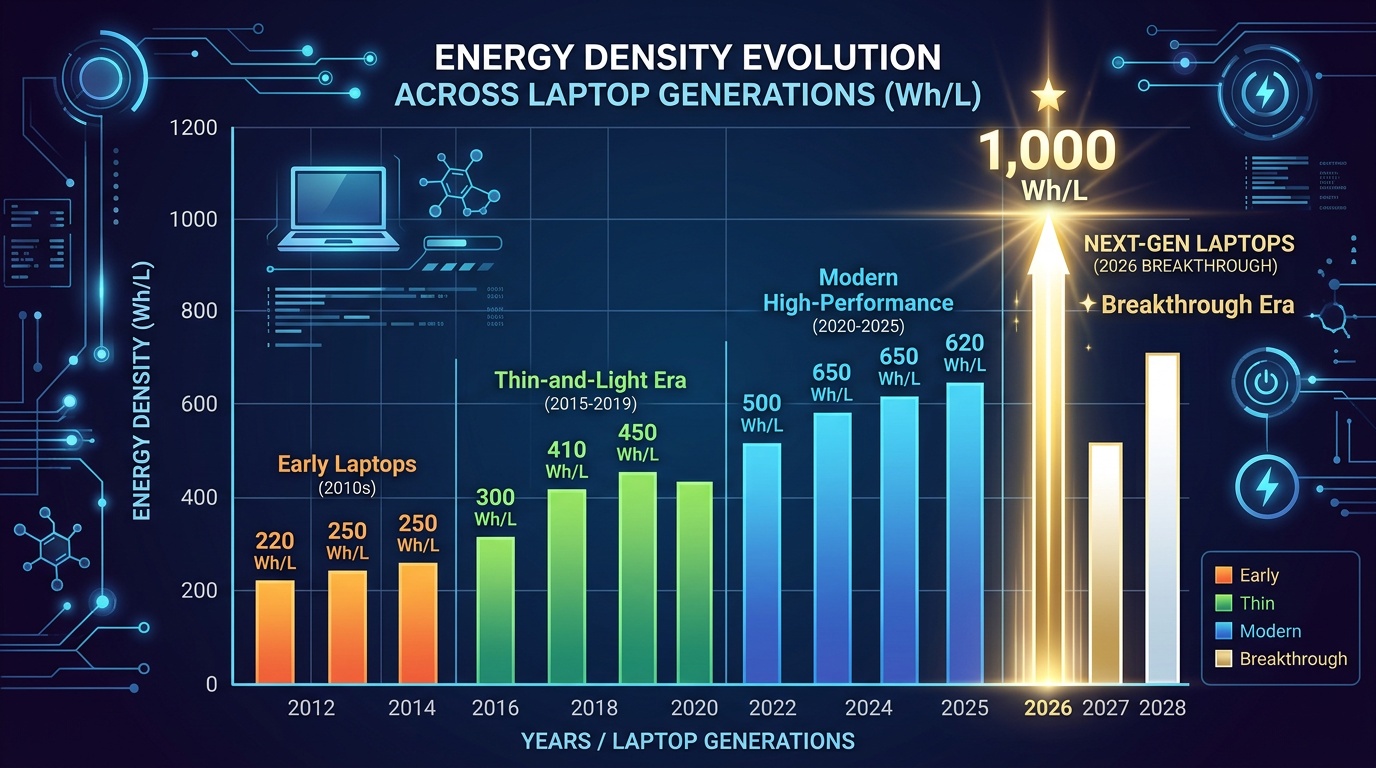
Lenovo recently shattered this paradigm. With the announcement of the ThinkPad P1 Gen 7, the company introduced the world’s first laptop battery with an energy density of 1,000 Watt-hours per Liter (Wh/L). This isn’t just an incremental spec bump; it is the arrival of the silicon-anode era.
A Volatile History: The Scars of Lithium-Ion
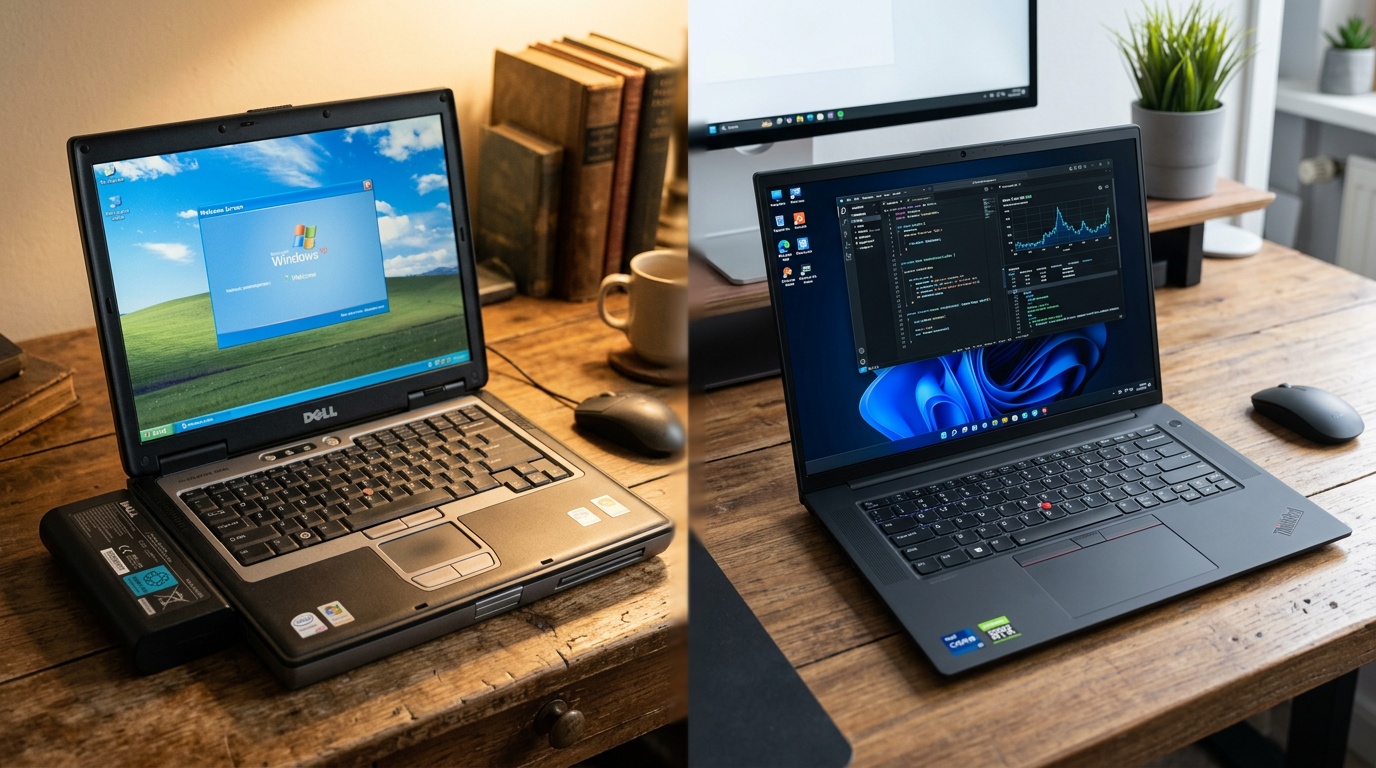
To understand why 1,000 Wh/L matters, we must look back at the checkered, and sometimes literal, “burn” rate of the battery industry. For thirty years, the standard Lithium-ion (Li-ion) cell has been our best friend and our worst enemy.
The early 2000s were a dark time for notebook reliability. We saw massive recalls from nearly every major manufacturer—Dell, Sony, and Apple included—as cells suffered from “thermal runaway.” Manufacturing impurities could cause internal short circuits, leading to spectacular, headline-grabbing fires. Beyond the safety risks, the longevity of these batteries was abysmal. Early Li-ion cells suffered from rapid capacity loss, often becoming glorified paperweights after just 300 charge cycles.
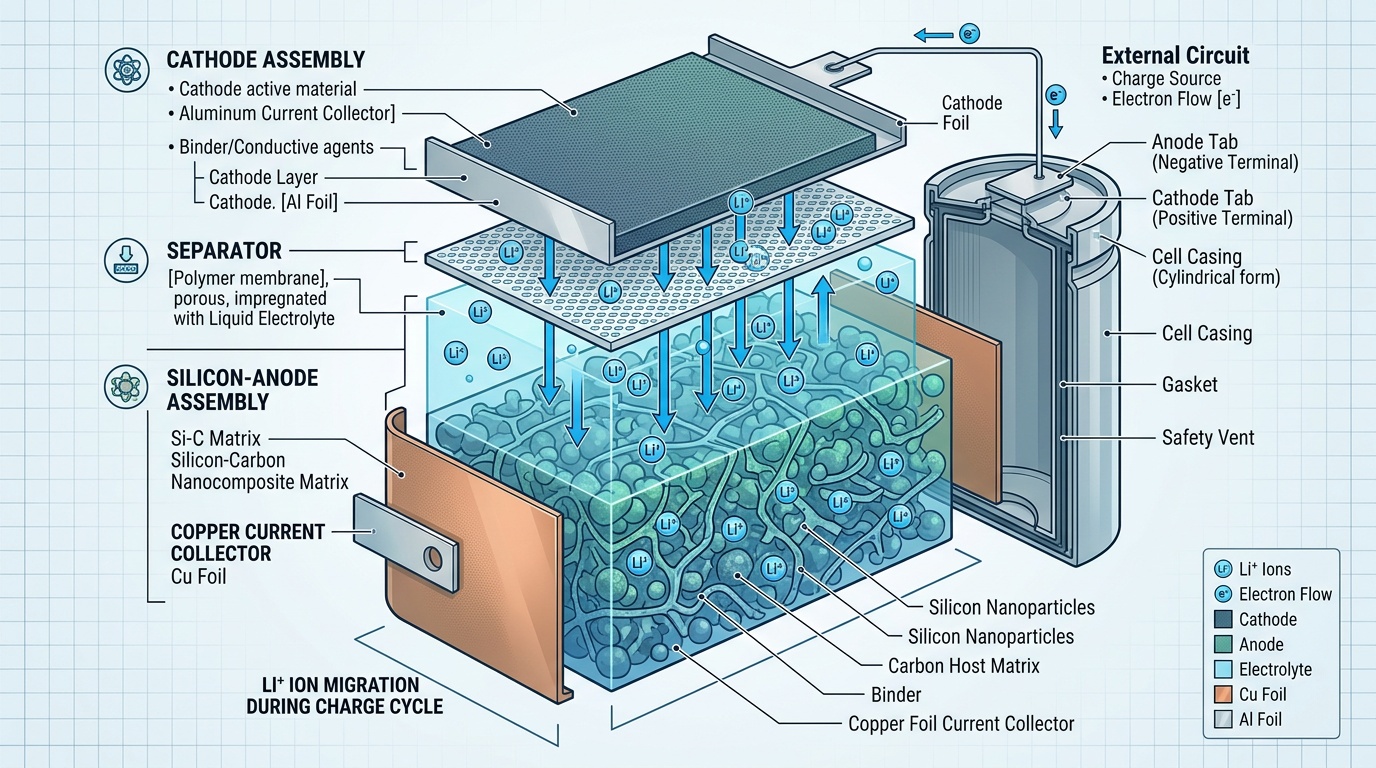
The industry eventually stabilized the chemistry, but we hit a physical wall. Traditional batteries use graphite anodes. While stable, graphite is bulky; it takes six carbon atoms to hold a single lithium ion. This limited how much energy we could cram into a thin laptop chassis without making the device thick, heavy, or dangerous.
The Science of Silicon: Breaking the 1,000 Wh/L Barrier
The “Holy Grail” of battery science has long been the silicon anode. Unlike graphite, silicon can theoretically hold ten times more lithium by weight. However, silicon had a fatal flaw: it expands by up to 300% when charging, causing the battery to literally self-destruct after a few uses.
Lenovo’s new 1,000 Wh/L technology, developed in partnership with industry innovators, uses a specialized silicon-carbon composite. By engineering the silicon at a nano-scale and housing it in a flexible carbon matrix, the battery can handle the expansion and contraction without cracking.
This jump to 1,000 Wh/L represents a massive leap in volumetric energy density. Standard high-end laptops usually hover between 600 and 700 Wh/L. By reaching the 1,000 mark, Lenovo is fitting roughly 40% more energy into the exact same physical footprint. This allows for a 90Whr battery in a chassis that previously could only hold 60-70Whr, all while maintaining the slim profile required by modern aesthetics.
Living Without the Tether: Meetings and Day Trips
The practical implications of this density shift are transformative. For the “typical” user—someone browsing, emailing, and using SaaS tools—this pushes real-world battery life deep into the 15-to-20-hour range.
More importantly, it changes the behavior of the power user. If you are a designer or an engineer using an AI-ready workstation, you no longer have to worry that a 90-minute rendering task will kill your machine before lunch.
This technology effectively makes the “charger-in-the-bag” a choice rather than a requirement. You can leave your 135W or 170W power brick at home for a day of client meetings. You can survive a cross-country flight without praying for an under-seat outlet that actually works. Because the density is higher, these batteries also support faster charging rates without the same level of heat degradation seen in older graphite cells, meaning a 30-minute “splash” charge provides significantly more runtime than it used to.
The Competitive Landscape: Who Else is Making the Jump?
Lenovo is the first to cross the finish line in a production laptop, but they aren’t alone in the race. The industry is pivoting toward this architecture as the “Silicon-Anode Revolution” takes hold.
- Porsche and the EV Influence: Companies like Sila Nanotechnologies have been working with Mercedes-Benz and Porsche to bring silicon-anode tech to electric vehicles. The trickle-down effect into consumer electronics was inevitable.
- Apple: While Apple rarely discusses its chemistry in public, patents suggest they are heavily invested in high-silicon content anodes to keep the MacBook Air thin while increasing the power draw for M-series chips.
- Honor and Xiaomi: In the smartphone space, Chinese manufacturers have already begun deploying “Silicon-Carbon” batteries in foldable phones to keep them thin. Lenovo’s achievement is scaling this technology to the much larger, higher-voltage requirements of a professional workstation.
The Impact on AI and High-Performance Computing
The timing of this battery breakthrough is not accidental. We are entering the age of the AI PC. With the integration of NPUs (Neural Processing Units) and power-hungry mobile GPUs like the NVIDIA RTX 3000 Ada Generation, the power draw of a laptop is increasing.
Without the 1,000 Wh/L jump, the “AI PC” would have been a desk-bound PC. To run local LLMs or AI-driven video editing, you need more “fuel” in the tank. Lenovo’s new battery architecture provides the overhead necessary to run these advanced features without the battery percentage falling like a countdown timer.
Wrapping Up
The shift to 1,000 Wh/L silicon-anode batteries is perhaps the most significant “under the hood” upgrade in the history of the ThinkPad. It addresses the three greatest pain points of the mobile era: the fear of fire, the frustration of battery degradation, and the constant anxiety of the empty percentage bar.
By leveraging the unique properties of silicon, Lenovo has managed to break a decade-long plateau in battery science. As this technology becomes the standard across the industry, we will finally see the “portable” in “portable computer” mean exactly what it says. The wall-huggers can finally stand up and move to the center of the room.

- Meta Finalizes Massive Teen Addiction Settlement, but Proposed App Restrictions Make Kids Less Safe - August 28, 2026
- The Aftermath of Corporate Overexpansion - August 25, 2026
- The 2026 Google Pixel 11 Pro Hits Thirty Hours of Battery Life but the New York Keynote Proved Google Wants You to Ignore It - August 21, 2026