In the technology sector, we spend an inordinate amount of time discussing the silicon—the massive GPUs, neural processing units, and sophisticated software stacks driving the next computing revolution. We dissect clock speeds, logic gates, and the nuanced distinction between true agentic AI executing high-level cognitive tasks versus standard software automation managing basic mechanical vehicle functions. But we rarely talk about the plumbing. The stark reality is that the global tech industry is running out of power and, critically, running out of water. Standard terrestrial data centers are colliding with rigid thermodynamic limits, consuming staggering amounts of electricity and municipal water just to prevent hardware from melting down.
The metrics governing this industry—Power Usage Effectiveness (PUE) and Water Usage Effectiveness (WUE)—are flashing red. Hyperscale facilities are struggling to drop PUE below 1.1 using traditional air cooling, expending massive facility overhead on thermal management. Simultaneously, water consumption has become a geopolitical liability; in 2024 alone, Microsoft reported using 5.8 billion liters of water, while Meta consumed 3.1 billion liters globally. We are reaching the physical boundaries of what terrestrial cooling can achieve sustainably. The long-term solution isn’t to build bigger air conditioners on land; it is to relocate the infrastructure entirely. This brings us to a strategic pivot happening off the coast of Hainan Island. The recent news that China Turns on the World’s First Underwater Data Center isn’t just a novel science experiment. It is a calculated, highly aggressive strategic maneuver that fundamentally redefines the economics, security, and sustainability of enterprise and military computing.
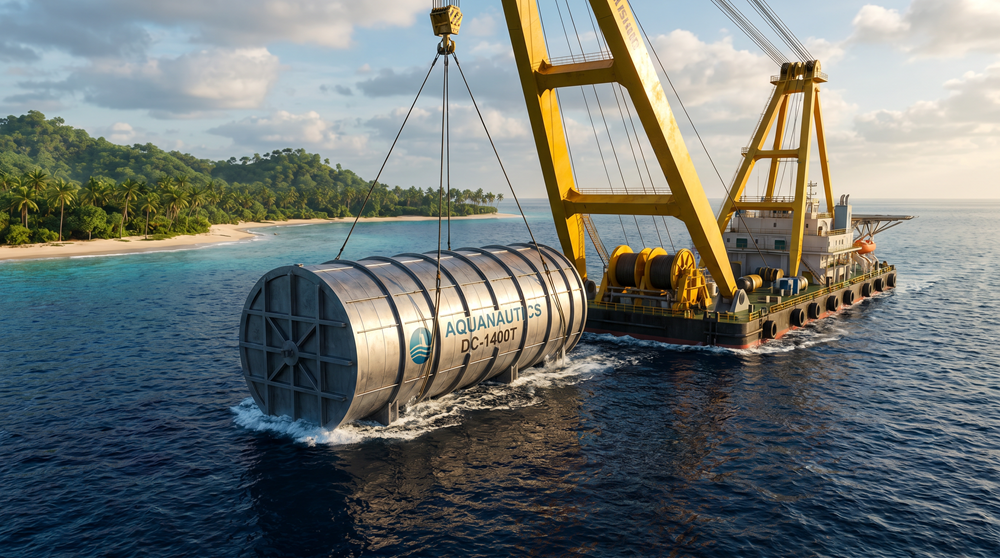
The Hainan Activation Validates the Concept
Located off the coast of Hainan Island, this deployment, spearheaded by the Chinese company Highlander—with heavy backing from the Chinese government—represents the first truly scalable commercial application of underwater data center (UDC) technology. The system itself is a 1,400-tonne module submerged 35 meters onto the seafloor, utilizing the surrounding seawater as an infinite, natural cooling sink.
But a single module is merely a proof of concept for a much broader strategy. Current development plans indicate a staggering 100 modules will eventually be deployed at the Hainan site. When you scale an underwater infrastructure to that magnitude, the operational economics entirely flip. By eliminating the need for mechanical chillers, complex heat exchangers, and evaporative cooling towers, Highlander is functionally erasing the cooling penalty that plagues terrestrial competitors.
This is not just about saving money on electricity; it is about reclaiming the billions of liters of municipal water that terrestrial data centers evaporate daily. In an era where water scarcity is an escalating crisis—with two-thirds of U.S. data center developments since 2022 placed in highly water-stressed regions – dropping the heavy compute load into the ocean is a pragmatic, scalable solution.
The Ghost of Project Natick and the Deployment Dilemma
To understand where Highlander and China are going, we have to look back at where Microsoft left off. The concept of the UDC isn’t entirely new, but its commercial viability has been intensely debated. In 2018, Microsoft launched Phase II of its highly publicized Project Natick, deploying a module roughly the size of a standard shipping container off the coast of Scotland’s Orkney Islands.
That experimental facility housed 864 servers in a nitrogen-rich environment and was powered entirely by renewable energy from nearby wind and solar farms. When Microsoft analyzed the data two years later, the results were eye-opening: the underwater data center exhibited a failure rate that was approximately one-eighth of what experts expected from traditional land-based data centers. Why did it perform so well? Without the oxygen and fluctuating humidity that cause component corrosion, and without fallible human technicians bumping into racks or unplugging cables, the hardware thrived in complete isolation.
So, if Project Natick was a resounding technical success, why hasn’t Microsoft sunk data centers off every major coast in America? The answer lies in the logistical friction of deployment. Deploying large-capacity underwater systems requires specialized maritime vessels, deep-sea rigging crews, and massive upfront capital. If a module fails critically, you cannot just send a technician down the hall with a replacement hard drive; you must winch a multi-ton pressure vessel up from the seafloor. Highlander and the Chinese government are betting that the long-term operational savings and strategic security advantages will easily offset these immense upfront deployment costs—a long-term infrastructure bet that Western tech giants, heavily bound by quarterly earnings pressures, have so far hesitated to make at full commercial scale.
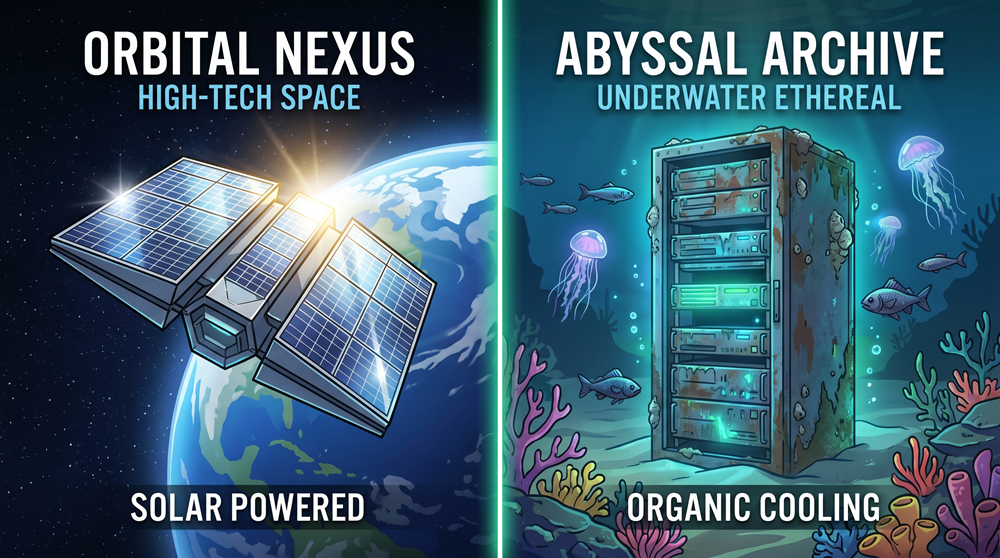
Deep Sea vs. Deep Space Hosted Computing
If the goal is to secure free cooling and infinite space, the ocean is not the only frontier being seriously considered by technologists. There is a growing push to relocate data centers into orbit, or even onto the surface of the Moon. Projects like the European Commission’s ASCEND study, led by Thales Alenia Space, and new theoretical frameworks for space-based machine learning infrastructures, argue for orbital data centers that tap directly into raw, unfiltered solar energy.
Advocates point out that space offers a flawless vacuum for insulation and passive radiative cooling that can directly achieve exceedingly low coolant temperatures (Feilden, n.d.). An orbital data center could theoretically capture continuous solar power without the interruptions of weather or the Earth’s day-night cycle, generating peak power roughly 40% higher than terrestrial solar farms.
However, when you analyze the sheer physics and logistics, the ocean easily beats orbit for the foreseeable future. The cost per kilogram to launch hardware into Low Earth Orbit (LEO) has dropped significantly thanks to reusable rocket technology, but it still cannot compete with the sheer cost-effectiveness of loading a module onto a marine barge. Furthermore, space computing suffers from extreme radiation hazards requiring expensive physical shielding—estimated at roughly $1.2 million per kilowatt of compute just for launch costs associated with the shielding’s weight.
If we look at Lunar data center proposals, the latency problem exacerbates. The communication delay to the Moon is roughly 1.3 seconds each way. For modern agentic AI systems dynamically processing complex cognitive layers, or edge automation handling high-speed financial trading, a 2.6-second round trip is functionally an eternity. Underwater data centers, conversely, can be situated mere miles off the coasts of major metropolitan hubs, leveraging the ocean’s thermal mass while maintaining sub-millisecond fiber-optic latency to the end-user.
Tracking Eco-Friendly Cooling Trends
The industry has not been sitting still on land, of course. We are witnessing a massive shift toward advanced terrestrial cooling technologies. Traditional air cooling is being rapidly replaced by direct-to-chip liquid cooling and full immersion cooling, where server components are completely submerged in a dielectric, non-conductive fluid.
These methods are highly effective at moving heat away from high-density processors. However, even the most advanced terrestrial immersion cooling systems require heat exchangers and secondary loops that eventually dump heat into the atmosphere or utilize massive evaporative cooling towers. This means they remain inextricably linked to the power grid and municipal water supplies. In regions facing severe droughts, the optics and economics of this massive consumption are drawing intense regulatory scrutiny, with states like California actively exploring stringent water reporting mandates and environmental review requirements for data centers.
Underwater data centers completely bypass this terrestrial constraint. They offer a zero-water-discharge solution where the generated heat is dissipated directly into the surrounding ocean currents. While there are valid environmental concerns regarding localized thermal pollution—warming the water immediately surrounding the module—the sheer volume of the ocean diffuses this heat far more efficiently than the atmosphere handles the localized output from terrestrial cooling towers. If managed properly, with adequate spacing and stringent environmental monitoring, UDCs rank at the absolute pinnacle of sustainable, eco-friendly data center designs.
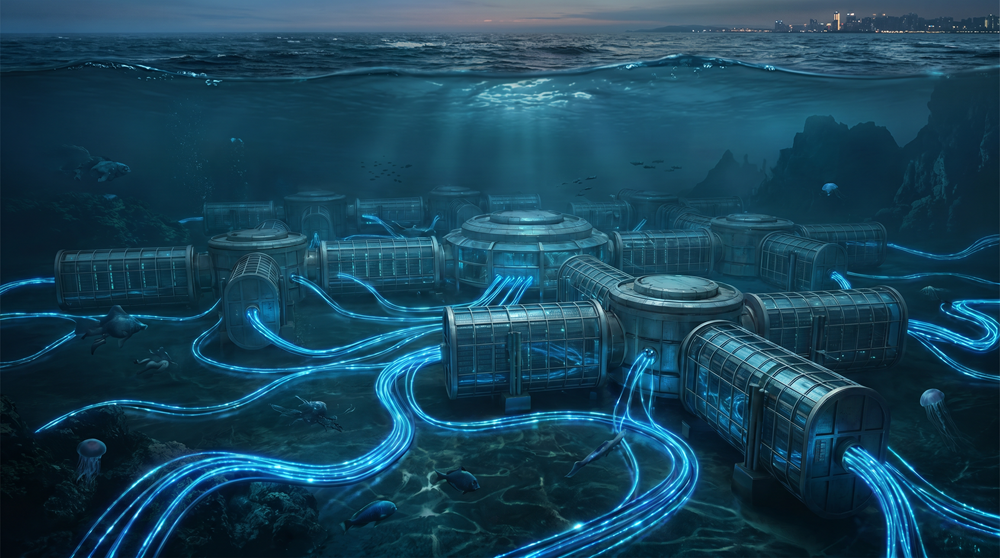
The 2030 Battlefield for Sovereign Infrastructure
As we project toward 2030, the race for infrastructure dominance will not be won in the cloud; it will be won in the ocean. Based on current development trajectories, China is uniquely positioned to be the undisputed global leader in underwater data center deployments. While European and American companies largely treat the concept as a fascinating research project, China is executing it as a matter of national infrastructure policy. The plan for 100 modules off Hainan Island is just the vanguard.
What does this leadership mean in practical terms? Commercially, it gives Chinese technology firms a massive competitive advantage in operational costs. By driving their cooling overhead to near zero, they can allocate a significantly higher percentage of their power budgets directly to AI computing. This translates directly to cheaper AI training costs and more robust digital services on the global market.
Militarily, the implications are profound and highly unsettling for Western defense analysts. Data centers are the nerve centers of modern warfare, controlling everything from autonomous drone swarms to strategic logistics and cyber operations. A terrestrial data center is a massive, static, easily identified target on satellite imagery. An underwater data center is hidden, inherently hardened against electromagnetic pulse (EMP) attacks by the surrounding seawater, and immensely difficult to target with conventional kinetic weaponry.
Of course, this physical isolation introduces entirely new vectors for sabotage. The underwater domain is notoriously difficult to secure against state-sponsored espionage or terrorist actors. Protecting these critical subsea assets requires an entirely new ecosystem of surveillance technologies. A robust defense strategy will mandate the continuous deployment of autonomous underwater vehicles (AUVs), remotely operated vehicles (ROVs), and smart sensor buoys to continuously detect tampering, manage legal disputes, and monitor environmental compliance (Abner & Bauk, 2024). The nation that masters both the deployment and the hardware-based defense of underwater data centers will possess a highly resilient, nearly invisible computing backbone capable of surviving disruptions that would instantly cripple terrestrial networks.
Wrapping Up
The activation of Highlander’s 1,400-tonne underwater data center off Hainan Island is a watershed moment for the technology sector. It proves unequivocally that the relentless thermodynamic and resource challenges of the AI era can be met by utilizing the planet’s largest natural heat sink. While space-based computing remains a fascinating theoretical pursuit hindered by exorbitant launch costs, extreme radiation shielding, and physics-defying latency, the deep sea offers immediate, scalable solutions to energy and water scarcity. Microsoft proved that hardware could survive and thrive in a sealed, nitrogen-rich subsea environment; China is now proving that the business model can scale globally. As we barrel toward 2030, the strategic advantage will abruptly shift to those who realize that the future of the cloud actually lies at the bottom of the ocean.
- The AI Tipping Point: How AMD’s MLPerf 6.1 Results Signal the End of Nvidia’s Monopoly - September 29, 2026
- AMD Achieves Datacenter Compute Power At IFA 2026, but Local Production Scaling Remains Difficult - September 28, 2026
- Motorola Edge 70 Plus Achieves Massive Battery Life but the Launch Exposes Dell’s Historic Mobile Collapse - September 21, 2026