
It began, as these things often do, with a nostalgic scroll through my social media feed. I was on Facebook when a post from one of my old IBM colleagues caught my eye. We were reminiscing about the “good old days” of enterprise tech rollouts. He wrote about the massive, almost obsessive amount of structured training we used to provide whenever a client deployed a new mainframe, database system, or software platform. In those days, a technology sale was fundamentally a training agreement; we knew that if the people didn’t understand the system, the project would fail.
Yet, as my colleague pointed out, this crucial practice has virtually evaporated with the advent of modern artificial intelligence. Today, providers pitch complex Generative AI and agentic platforms as if they are simple consumer apps – plug-and-play miracles that require nothing more than an internet connection and a login.
This sudden elimination of structured training has had predictable, catastrophic results. We are witnessing an unprecedented spike in failed enterprise AI projects. Billions of dollars are being thrown into a digital graveyard of “proof-of-concept” experiments that never scale because the human beings tasked with using them have no idea how to actually integrate them into their daily workflows.

Why Cutting Training Costs Is an Executive Fast Track to Wasted Capital
In our haste to ride the AI wave, we have forgotten basic organizational psychology. A study by Cornerstone on The Silent Rise of AI at Work reveals a deeply troubling trend: while 8 in 10 employees are actively using AI tools in some form, a staggering 44% of U.S. workers have received absolutely no formal training on them. Even worse, more than half of those employees hide their AI usage from their managers due to a lack of clear organizational structures and policies.
This “silent rise” of untrained AI usage is a ticking time bomb. AI is not static software; it is highly dynamic, probabilistic, and prone to “hallucinations” – errors where the system confidently generates completely fabricated data. When untrained employees use these tools, they often fall victim to the “reasoning illusion”. They assume the AI understands math or logic when, in reality, it is simply performing advanced statistical pattern matching.
Without proper training, organizations face massive operational waste and critical mistakes:
- Operational Waste: Employees spend hours writing poorly structured prompts, receiving subpar outputs, and manually correcting errors that could have been avoided with standard prompt engineering techniques.
- Compliance and Security Risks: Untrained staff regularly paste proprietary corporate source code, sensitive financial spreadsheets, or private customer data into public AI models, completely bypassing security protocols.
- The Hallucination Trap: Without rigorous verification training, employees publish AI-generated reports containing non-existent legal citations, inaccurate product specifications, or deeply flawed market projections.
To maximize the massive potential of these platforms and eliminate this staggering waste, we must treat AI training not as an optional luxury, but as an absolute prerequisite for deployment.
Evaluating the Enterprise AI Landscape to See Who Wins the Training War
When you look at the current landscape of AI providers, a massive gap emerges between companies that simply sell software and those that sell actual business outcomes. Most of the hyperscale cloud providers are content to drop their API keys or software suites on your desk and walk away. But a select few are doing an exemplary job of bridging this skills gap.
Lenovo and the Human-as-a-Service Model
Lenovo has emerged as a standout leader in this space with its AI Center of Excellence and its customized deployment strategies. Instead of just selling high-end server hardware or AI software stacks, they deploy hybrid teams of data scientists, solution engineers, and AI architects to work directly with client teams. They understand that success requires co-creating workflows and training internal staff to maintain them, which is exactly how they helped DreamWorks safely integrate AI into complex animation pipelines.
IBM and the Legacy of Deep Enablement
IBM has also maintained its historical focus on deep client enablement. Through its consulting arm and Watsonx orchestrations, IBM focuses heavily on data literacy and model training. They ensure that enterprise buyers understand the data lineage and the explicit training methodologies behind their models, minimizing the risk of model drift and unexpected behavioral anomalies.
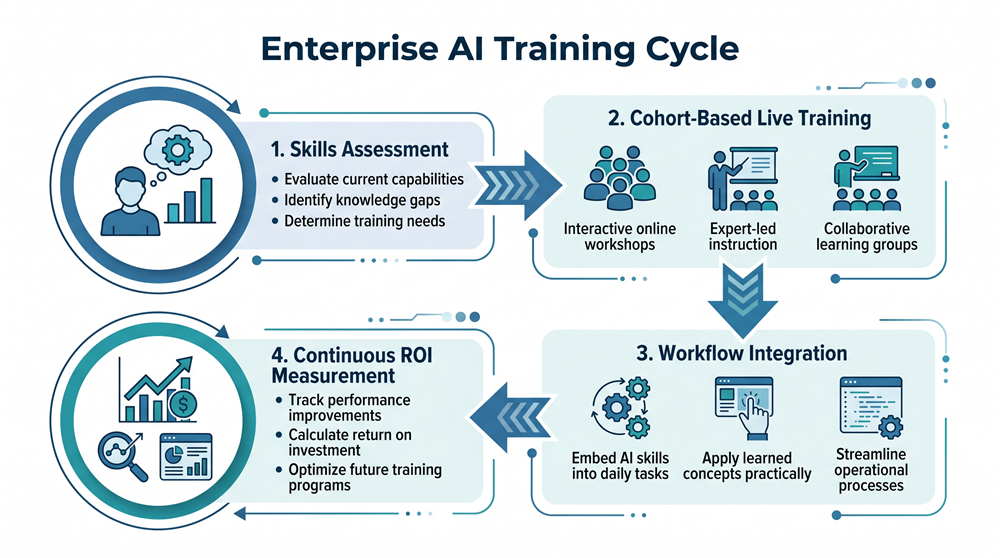
In addition to technology vendors, dedicated enterprise enablement firms like Correlation One have stepped up to fill the void. By providing live, cohort-based, stack-agnostic training designed around real enterprise workflows, they have demonstrated how to turn raw AI investments into measurable productivity gains.
Solving the Cost Equation with Localized Small Language Models
One of the most frequent excuses executives make for avoiding comprehensive training is the sheer cost of deploying and running high-end AI models for educational purposes. Training hundreds of employees on massive, cloud-hosted models incurs significant API costs, latency issues, and data privacy concerns.
Fortunately, the rapid rise of localized edge-AI hardware has opened up a highly efficient alternative. By leveraging low-cost, localized Small Language Models (SLMs) running directly on modern, NPU-equipped laptops (such as those powered by AMD’s Ryzen AI processors or Intel’s Core Ultra chips), companies can create highly customized, secure training sandboxes.
These localized SLMs can be trained on a company’s internal documentation, standard operating procedures, and legacy project files. They can serve as dedicated, always-on “training co-pilots” that guide employees through interactive, simulated workflows without sending a single byte of data to the public cloud. This localized approach drastically slashes operational training costs while giving employees a safe environment to learn, make mistakes, and master prompt structures without consequences.

Why We Urgently Need AI Certifications and Standardized Educational Metrics
If you wanted to deploy an enterprise database in 1998, you hired a certified database administrator. If you wanted to build a secure corporate network, you looked for engineers with verified Cisco certifications. Yet today, organizations routinely hand the keys to multi-million-dollar AI infrastructures to employees whose only credential is that they “played around” with a chatbot over the weekend.
This lack of standardization is a recipe for operational chaos. We urgently need robust, universally recognized AI certifications and professional education standards to:
- Define Core Competencies: Standardized credentials must move beyond basic “AI literacy” and evaluate deep, practical capabilities in data security, ethical model utilization, prompt optimization, and output verification.
- Protect Corporate Assets: Standardized training ensures that any certified AI practitioner understands the legal, privacy, and regulatory landscapes surrounding machine learning models.
- Establish Clear Benchmarks: Organizations must be able to objectively measure their workforce’s AI maturity index before making massive capital investments in next-generation agentic systems.
Until the tech industry treats AI competency as a formal, measurable, and certifiable professional discipline, we will continue to see high failure rates and squandered budgets.
The Relentless Evolution of AI Demands Aggressive and Repeated Upskilling
The final, and perhaps most dangerous, mistake that enterprise leaders make is viewing AI training as a single, one-off event. They organize a half-day seminar, check the training box on their HR ledger, and assume their workforce is fully equipped for the future.
But AI is not a static tool; it is evolving at an exponential pace that makes traditional software cycles look prehistoric. In less than three years, we have transitioned from basic text generators to complex multi-modal platforms, and we are now actively deploying autonomous, agentic AI systems that can plan, execute, and monitor multi-step tasks without human intervention.
This continuous evolution means that yesterday’s prompt techniques are rapidly becoming obsolete. As models become more agentic, human roles will shift from creators to editors, auditors, and systems analysts.
Companies that deploy AI must commit to a culture of aggressive, continuous, and repeated training. You cannot expect your team to safely navigate the complexities of autonomous agent networks using training they received during the simple chatbot era. If you do not continuously upskill your workforce, your systems will quickly become insecure, your workflows will break, and you will find your organization left behind in an incredibly fast-moving market.
Wrapping Up
The technology industry has spent the last few years selling the dream of effortless, automated productivity. But the stark, multi-billion-dollar reality is that there are no shortcuts to successful digital transformation.
My old IBM colleague’s Facebook post was a timely reminder of a foundational truth we should never have forgotten: technology is only as good as the human beings who operate it. By abandoning structured, aggressive training in our rush to deploy AI, we have created an unsustainable environment of failed projects, wasted capital, and massive security vulnerabilities.
To unlock the true, transformative potential of artificial intelligence, we must completely reject the illusion of “plug-and-play” deployment. Enterprise leaders must partner with providers that actively prioritize human enablement, leverage secure localized models to reduce educational costs, demand rigorous standardized certifications, and commit to a relentless cycle of continuous, repeated upskilling.
Only when we train our people as aggressively as we build our models will AI finally live up to its promise.

- Meta Finalizes Massive Teen Addiction Settlement, but Proposed App Restrictions Make Kids Less Safe - August 28, 2026
- The Aftermath of Corporate Overexpansion - August 25, 2026
- The 2026 Google Pixel 11 Pro Hits Thirty Hours of Battery Life but the New York Keynote Proved Google Wants You to Ignore It - August 21, 2026