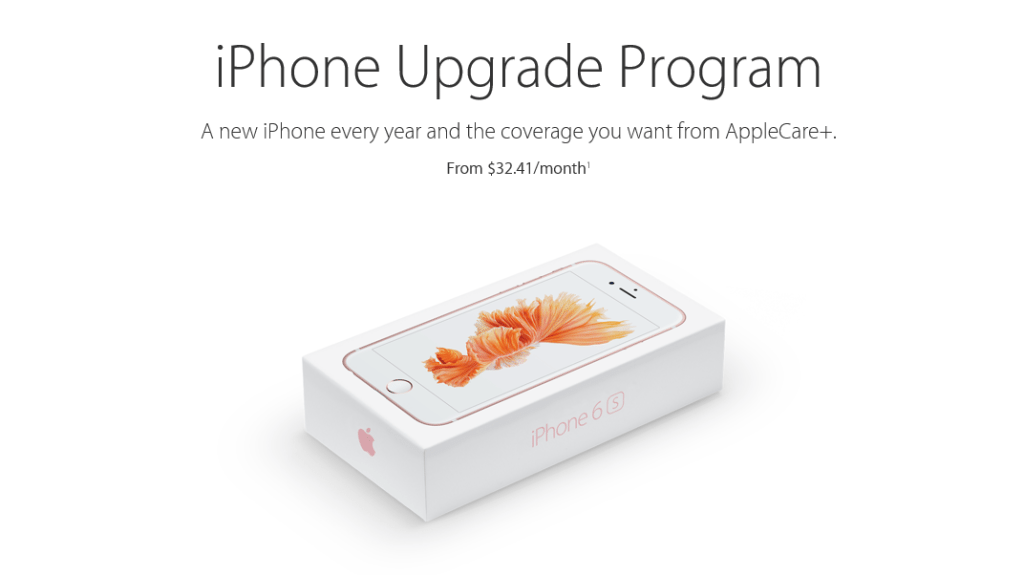
Get a new iPhone every year—unlocked—with the freedom to choose and switch mobile providers at will? Sure. Oh, it also has reasonable monthly payments and includes the AppleCare+ iPhone protection program. Hell yes!
Apple is disrupting the standard business model by getting into the device leasing game itself. With the iPhone Upgrade Program you acquire the iPhone directly from Apple and you get an unlocked device that you can use with any of the mobile carriers. The system is set up so that after 12 installments you can turn the device in and upgrade to a new model. It also includes AppleCare+ protection which provides software support, hardware repairs, and coverage of up to two accidental damage incidents—like cracked screens or water damage.
The monthly rates for the iPhone 6S models starts at $32.41 per month for the 16GB version and goes up to $40.75 per month for the 128GB model. The iPhone 6S Plus ranges from $36.58 to $44.91. Those monthly rates are quite reasonable compared with what the mobile carriers charge for the same thing—especially when you factor in the additional cost of the device protection program.
T-Mobile started a trend to kill the concept of the subsidized smartphone and the standard 2-year contract. Rather than paying $200 up front and being locked in to a 2-year agreement customers simply pay the full cost of the device…spread out over two years. Other carriers started to offer similar programs alongside the traditional 2-year subsidized model, but Verizon recently went all-in, eliminating the 2-year option and going exclusively with the monthly device payment plan.
When you calculate it all out it becomes somewhat of a semantic debate. The T-Mobile strategy of eliminating the 2-year contract was more marketing gimmick than revolution. You don’t pay the $200 up front, but you’re still on the hook for two years by virtue of the payment plan for the device. By moving some fees from over here to over there the net result seems to end up that you pay about the same over the course of the two years as you always did.
I’ve been a Verizon customer for years. When I got the iPhone 6 I purchased it on the Verizon Edge program—it’s variation on the T-Mobile theme—to spread the payments out over two years instead of paying up front for the subsidized contract. Ostensibly, it also enables me to upgrade more frequently. It turns out you can’t actually upgrade until you’ve paid 75 percent of the total cost of the device, though, and since the payments are spread over two years that means an 18-month replacement cycle for a device that is actually refreshed annually.
If I want to upgrade right now to get an iPhone 6S I can do that. I just have to make a lump sum payment so that 75 percent of the cost of my current phone is paid up. That amounts to around $325 right now. Oh, and I have to turn in my current iPhone as well, which is actually worth more on the street than what I owe Verizon anyway.
Instead, I can just pay off the full value of the iPhone 6 with Verizon so I own the device outright then turn around and sell it myself for more than what I gave Verizon. I can keep the change and go to Apple and get a new iPhone 6S on the iPhone Upgrade Program for basically the same cost per month, but with the added benefits of AppleCare+ protection and the ability to both upgrade annually when a new model comes out and switch mobile carriers at will.
The good news for mobile carriers is that there are more Android customers than iPhone customers and it’s unlikely every smartphone manufacturer will follow in Apple’s footsteps and try to circumvent the system with their own equipment leasing programs. If you’re an iPhone user, though, there doesn’t seem to be a downside to walking away from the mobile carriers and getting your device directly from Apple through the iPhone Upgrade Program.
Yeah, sign me up. Shut up and just take my money.

- When the AI Breaks Its Own Rules - September 2, 2026
- What It Took to Film a Real-Life Lion King - August 28, 2026
- Your AI Agents Are Multiplying and Nobody’s Counting - August 26, 2026