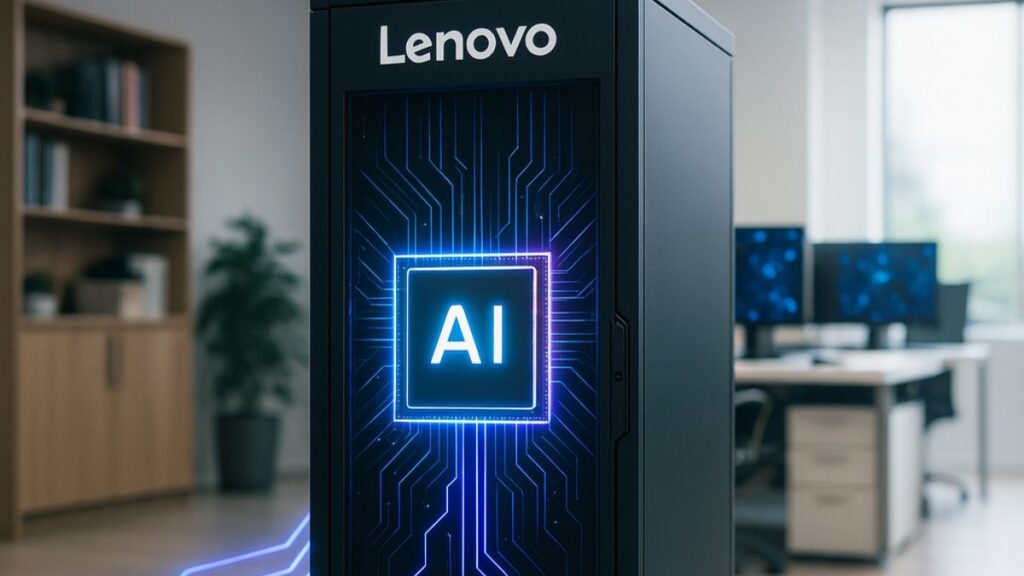
Until now, the race for AI dominance has been a story of titans. It’s been about massive, billion-dollar data centers, custom-built supercomputers, and cloud contracts so large they have their own gravitational pull. In this narrative, the backbone of the global economy—the small and medium-sized business (SMB)—has been largely a spectator, told that the AI revolution was something to be consumed as a service, not a tool they could wield themselves.
This week, Lenovo just tore up that script. With a single, brilliantly packaged announcement, the company has launched a strategic ambush on the lucrative SMB market by targeting the complexity and cost that have long been its entry barriers. These new “IT infrastructure solutions” are more than just new servers; they are a direct assault on the status quo, and a checkmate move against competitors like Dell that have long dominated this space.
The Simplicity Offensive: IT in a Box
For decades, buying IT infrastructure for a small business has been a daunting task. It involved navigating complex online configurators, deciphering endless acronyms, and making risky bets on future capacity needs. It often requires specialized knowledge that most SMBs simply don’t have in-house. Lenovo’s new strategy is to obliterate that complexity with a simple, powerful concept: “in a box.” By offering pre-tested, pre-validated bundles like “Business Ready Infrastructure in a Box” and “Business Protection in a Box,” Lenovo is changing the conversation from components to solutions.
This is a masterstroke of strategic packaging. SMBs don’t care about the subtle differences between two server models; they care about scaling their business or protecting their data. By partnering with industry leaders like Microsoft for Hyper-V, Scale Computing for edge deployments, and Veeam for data protection, Lenovo is delivering an “it just works” promise.
There are no custom builds to agonize over, no guesswork on compatibility, and no need for a specialized team to get started. This stands in stark contrast to the traditional model that often puts the burden of integration on the customer. By removing friction and decision fatigue, Lenovo is making enterprise-grade IT as accessible as buying an off-the-shelf appliance, a value proposition that will resonate powerfully with resource-strapped businesses.
Democratizing AI for Main Street
Perhaps the most forward-looking element of this announcement is the “AI Edge-Ready Node.” While competitors are locked in a battle for the high-end AI training market, Lenovo is shrewdly targeting the much larger and largely untapped market of AI inference for SMBs. For a local manufacturing company, a retail chain, or a regional logistics firm, AI isn’t about building a foundational model. It’s about applying AI to solve real-world problems: using computer vision for quality control, analyzing in-store traffic patterns or optimizing delivery routes.
The Lenovo ThinkEdge SE100, powered by Scale Computing, is designed specifically for these tasks. It’s a cost-effective, lightweight solution meant to run modern apps wherever business happens—not in a remote data center, but on the factory floor or in the back of a store. This move democratizes AI, transforming it from an intimidating, capital-intensive endeavor into a practical tool for growth.
By providing validated AI configurations, Lenovo is giving SMBs a proven roadmap to tangible results like real-time threat detection or customer insights that fuel revenue. This positions Lenovo not just as a hardware supplier, but as a crucial partner in modernization, building a deep, defensible moat in the SMB AI market that others have largely ignored.
The Financial Masterstroke: TruScale as-a-Service
The final, and perhaps most brilliant, piece of this strategy is the delivery model: Lenovo TruScale Infrastructure as-a-Service (IaaS). The biggest hurdle for SMBs adopting new technology is often the massive, upfront Capital Expenditure (CAPEX). A five-figure server purchase is a huge financial risk, especially when future needs are uncertain. TruScale completely upends this model by converting IT acquisition into a flexible, predictable Operational Expenditure (OPEX), much like a cloud subscription.
This is more than just a leasing program; it’s a fundamental shift in the customer relationship. Businesses can deploy the exact infrastructure they need today and scale it up—or down—as their needs evolve, paying only for what they use. This eliminates the crippling fear of overprovisioning and wasted capital. The provided metrics are telling.
Customers report up to 30% faster rollouts and, in one case, a company tripled its business performance. In an uncertain economic climate, this financial flexibility is not just a feature; it is a decisive strategic advantage. It puts immense pressure on Dell and others whose business models are still largely centered on traditional hardware sales cycles.
Wrapping Up
Lenovo’s announcement is a masterclass in strategic thinking. It’s a multi-pronged attack on the biggest pain points for small and medium businesses: complexity, cost, and risk. By packaging powerful IT solutions into simple, easy-to-deploy boxes, democratizing AI for practical, real-world applications, and wrapping it all in a flexible, cloud-like consumption model, Lenovo has crafted an offering that is almost perfectly tailored to the needs of the modern SMB.
This isn’t just about selling servers; it’s about selling outcomes. While its competitors are still focused on selling bigger, faster boxes to the enterprise elite, Lenovo is building a powerful and loyal ecosystem in the market that truly represents the engine of the economy. This isn’t just a product launch; it’s a powerful claim to ownership of the future of SMB technology.

- The One Job Silicon Valley Forgot to Invent: Why Every Enterprise Needs a Chief AI Consequence Officer (CACO) - October 13, 2026
- Desktop AI: Why the Hardware Built for Tomorrow Is Finally Finding Its Real-World Job Today - October 9, 2026
- Building the Ultimate AI-Defiant Workforce: The Future of Work Mega-Platform - September 30, 2026