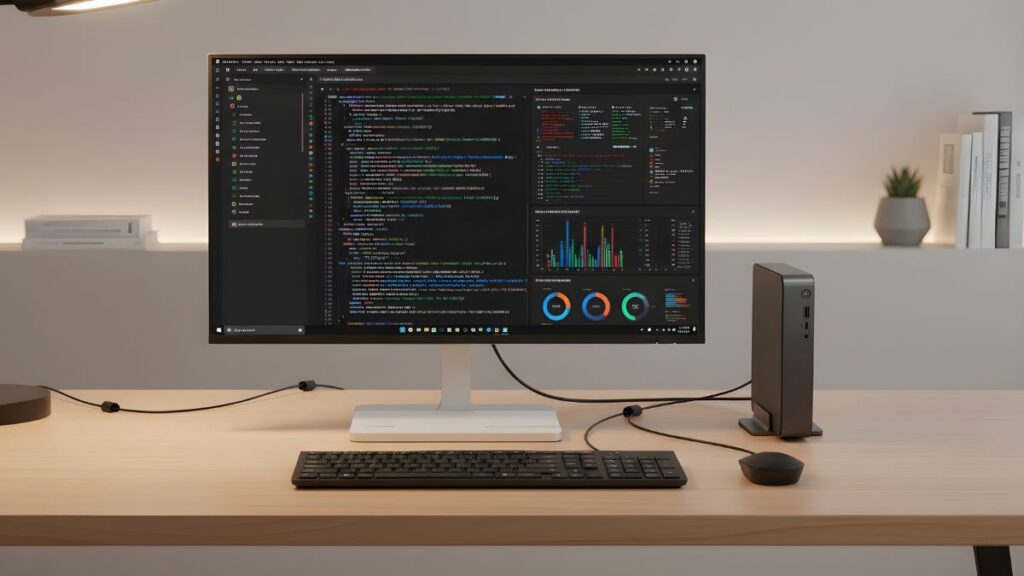
For the last year, the tech industry has been buzzing about the “AI PC.” We’ve seen a parade of laptops featuring Qualcomm’s Snapdragon X Elite and Plus chips, promising MacBook-level battery life and integrated Neural Processing Units (NPUs) capable of local AI tasks. But for many power users, developers, and enterprise IT managers, there has been a glaring omission: a desktop.
Laptops are mobile marvels, but they are not the foundational bricks of a software ecosystem. Desktops are. The recent release of the Lenovo IdeaCentre Mini x Gen 10 (Snapdragon) marks a pivotal moment not just for hardware enthusiasts, but for the entire Windows on ARM platform.
The Developer Disconnect
One of the most significant hurdles preventing Qualcomm from truly challenging the x86 duopoly (Intel and AMD) has been a “chicken and egg” software problem. To get robust, native ARM64 applications, you need developers building them. To get developers building them, you need affordable, accessible, and always-on hardware.
For months, developers were left waiting for Qualcomm’s own “Snapdragon Dev Kit,” a mini-PC that was supposed to bridge this gap. Unfortunately, that project ended in cancellation and refunds, leaving a massive hole in the market. You simply cannot expect a software revolution to happen if every developer is forced to work off a laptop. Developers need headless build servers; they need test benches that sit in a server closet; they need machines that don’t go to sleep when the lid is closed.
The lack of these machines created a vacuum. Without easy access to desktop-class Snapdragon hardware, the porting of essential enterprise tools and niche creative applications slowed. This is why the Lenovo IdeaCentre Mini x is so critical. It isn’t just a consumer device; it is the development rig that the software ecosystem has been starving for. By providing a stable, commercially available desktop with the Snapdragon X Plus 10-core processor and its 45 TOPS NPU, Lenovo has essentially handed developers the keys to finally build the AI PC future we’ve been promised.
Unmatched Efficiency for the Green Home
Beyond software development, there is a practical, physical argument for this machine that is often overlooked: energy independence. We are living in an era where solar panels on homes and businesses are becoming commonplace. For those of us trying to live “off-grid” or simply minimize our carbon footprint, the traditional x86 desktop is a vampire.
A standard gaming rig or high-performance workstation can idle at 100+ watts and spike to 500+ watts. In contrast, the ARM architecture used in the IdeaCentre Mini x is derived from mobile technology. It sips power rather than gulping it.
For a small business running digital signage, a home lab enthusiast running a 24/7 server, or a writer working from a solar-powered cabin, this efficiency is a game-changer. You get a fully functional Windows 11 Pro desktop that performs remarkably well while consuming a fraction of the energy of its predecessors. It allows users to keep their digital lives running without draining their battery banks overnight.
Gaming: Managing Expectations and Surprises
Let’s be clear: The IdeaCentre Mini x is not a gaming machine. It relies on the integrated Qualcomm Adreno GPU, which is designed for media consumption and productivity, not ray-traced ultra-settings gaming. However, the emulation layer on Windows on ARM has quietly become impressive.
To test this, I loaded up my personal favorite game: City of Heroes. This is a massively multiplayer online role-playing game originally released in 2004. It relies on older DirectX APIs that can be tricky for modern emulators. To my surprise, the system didn’t just launch it—it played it. I was able to run around Paragon City with decent settings, engaging in combat without game-breaking lag.
While you won’t be playing Cyberpunk 2077 at 4K, the fact that this ARM chip can translate and run legacy x86 game code from two decades ago smoothly is a testament to how far software compatibility has come. It validates the machine as a viable “light entertainment” box for the living room.
The Lenovo Playbook: Threadripper to Snapdragon
Lenovo’s release of this desktop isn’t just a random product launch; it’s a strategic maneuver that mirrors their conquest of the high-end workstation market.
Years ago, when Intel Xeons dominated the professional workstation landscape, Lenovo was the first major OEM to take a gamble on AMD. It launched the ThinkStation P620, the world’s first Threadripper Pro workstation. Competitors hesitated, doubting the ecosystem or the demand for AMD in the enterprise. Lenovo didn’t wait. It cornered the market, providing unmatched core counts to visual effects artists and data scientists who were desperate for that power.
They are doing the exact same thing now with Qualcomm. While other manufacturers are dipping their toes in with a laptop or two, Lenovo is diving in with a desktop form factor, legitimizing the Snapdragon X platform for a broader range of use cases. By embracing the “IdeaCentre Mini x” now, Lenovo is positioning itself as the go-to hardware partner for the next generation of AI-driven computing, just as it did with high-performance thread-heavy computing.
The Future of the Micro PC
As we look forward, the traditional tower PC seems increasingly endangered in the general office and home environment. As AI advances, the need for massive, hot, loud local graphics cards for general tasks diminishes. The NPU is becoming the new engine of productivity.
With features like Microsoft Copilot+ integrated directly into Windows, tasks like real-time translation, advanced noise suppression, and local image generation are handled by the NPU. This Lenovo IdeaCentre Mini x packs 45 TOPS (trillion operations per second) of AI performance into a 1-liter chassis.
For 90% of office workers and home users, this is the future. A silent, tiny box that hides behind a monitor, draws negligible power, yet possesses the specialized silicon required to run the next generation of AI assistants. The era of the “big beige box” is long dead, but the era of the “black monolith tower” might be ending too, replaced by these intelligent, efficient bricks.
Wrapping Up
The Lenovo IdeaCentre Mini x (Snapdragon) is more than just another SKU in a catalog. It is a necessary piece of hardware that solves a critical developer shortage, offers a lifeline to energy-conscious users, and proves that ARM desktops can handle legacy entertainment. By following their successful Threadripper strategy, Lenovo has once again beaten the competition to the punch, offering a product that defines the transition to the AI PC era. Whether you are a developer compiling ARM64 code, a solar-powered homeowner, or just someone who wants to revisit City of Heroes without spiking your electric bill, this little box demands your attention.

- Meta Finalizes Massive Teen Addiction Settlement, but Proposed App Restrictions Make Kids Less Safe - August 28, 2026
- The Aftermath of Corporate Overexpansion - August 25, 2026
- The 2026 Google Pixel 11 Pro Hits Thirty Hours of Battery Life but the New York Keynote Proved Google Wants You to Ignore It - August 21, 2026