In my decades covering the enterprise technology sector, I have rarely witnessed a market inversion as swift, dramatic, and consequential as the one unfolding right now. For years, the conventional wisdom in Silicon Valley was that NVIDIA could walk on water, propelled by an insatiable appetite for artificial intelligence infrastructure and held together by the singular, charismatic gravity of its co-founder, Jensen Huang. Meanwhile, rivals were often viewed as mere alternatives used primarily to keep pricing somewhat honest. That narrative hasn’t just shifted; it has shattered.
With the formal launch and immediate shipping of AMD’s 6th Generation EPYC processors – codenamed “Venice” – built on TSMC’s bleeding-edge 2nm (N2P) process, AMD has delivered a generational knockout punch. Yet, in technology, product execution is only half the battle; timing is everything. AMD is rolling out its most dominant data center portfolio to date at the exact moment NVIDIA is engulfed in an unprecedented corporate governance and leadership crisis. When you combine architectural superiority with a sudden, massive vacuum in industry trust – and throw in a brilliant software solution to the crippling DRAM shortage known as MEXT – you get a foundational realignment of the data center landscape that will echo for the rest of the decade.

The Trust Deficit: Why Lisa Su Now Wears the AI Crown
Enterprise CIOs, hyperscale architects, and sovereign AI directors are inherently risk-averse. When they commit billions of dollars to multi-year data center buildouts, they aren’t just buying silicon roadmaps; they are buying leadership stability, supply chain predictability, and corporate governance. For thirty years, Jensen Huang was NVIDIA. He personally held the keys to the kingdom, managing the intricate web of relationships spanning TSMC, memory suppliers, and sovereign wealth funds.
However, the stunning revelations surrounding Huang’s personal misconduct and immediate resignation, alongside the subsequent independent board investigation into potential foreign intelligence targeting, have sent shockwaves through the global tech ecosystem. Because NVIDIA operated for decades without a clear, battle-tested succession plan—relying instead on a “hub-and-spoke” management structure centered entirely around its founder—installing an interim CEO while navigating the high-stakes leadership transition creates massive execution risk. When security clearances, national security implications, and key supplier allocations are suddenly thrown into question, enterprise buyers freeze.
Contrast this turbulence with Dr. Lisa Su at AMD. Since taking the helm, Su has operated as the antithesis of the flashy, rock-star tech billionaire. She is an engineer’s engineer – methodical, transparent, relentlessly focused on execution, and completely free of personal drama. Under her stewardship, AMD has hit every single architectural roadmap milestone like clockwork, from Zen 1 all the way to today’s 2nm Zen 6 Venice processors. In an industry suddenly waking up to the catastrophic risks of “key-person dependency” and governance lapses, Lisa Su has organically ascended to become the most trusted CEO in artificial intelligence and enterprise computing. When Lisa Su promises a hyperscaler that Verano and Venice-X will ship in 2027, followed by Zen 7 “Florence” in 2028, the board of directors on the buying side knows they can take that commitment to the bank without worrying about a midnight press release derailing their infrastructure strategy.
The Memory Bottleneck and the Genius of AMD’s MEXT
While leadership stability dominates boardroom discussions, data center operators on the ground are fighting a brutal operational war on two fronts: power constraints and a crippling memory crisis. As AI models transition from monolithic training runs to persistent, multi-agent inference and complex electronic design automation (EDA) workflows, system memory has become the ultimate bottleneck.
Why is memory so scarce and prohibitively expensive? Because memory fabrication giants have pivoted massive amounts of wafer capacity toward manufacturing High Bandwidth Memory (HBM3e and HBM4) for AI accelerators, starving the broader market of standard high-capacity DDR5 server DIMMs and driving DRAM prices through the roof. Over-provisioning servers with 1.5TB to 3TB of physical DRAM just to prevent Out-Of-Memory (OOM) application crashes is destroying data center budgets.
Rather than simply telling customers to buy more exorbitant memory sticks to populate Venice’s 16-channel DDR5 controllers, AMD approached the problem laterally with a breakthrough software-defined architecture: MEXT (Predictive Memory Software).
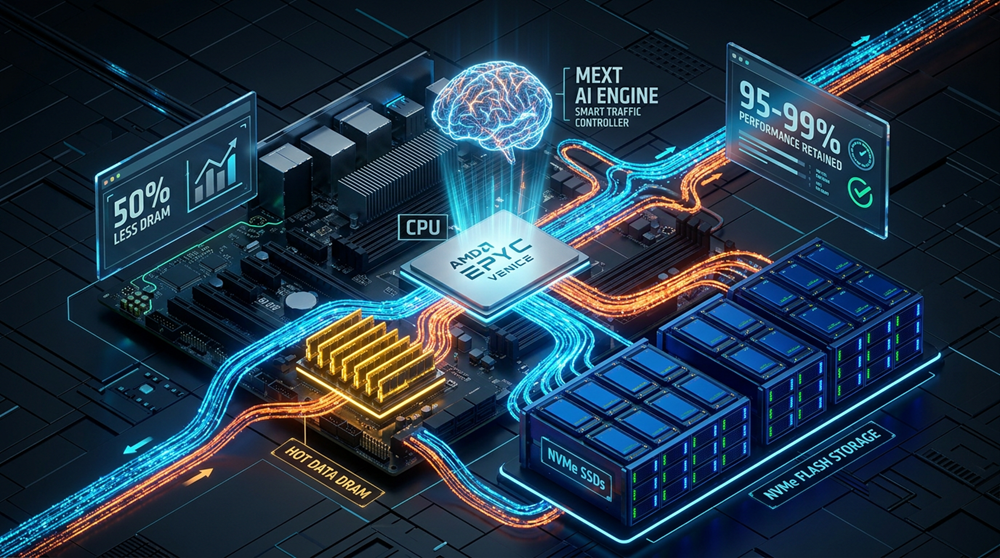
MEXT fundamentally alters server economics by allowing standard, inexpensive NVMe flash storage—which is roughly 50 times cheaper per gigabyte than DDR5—to masquerade as system DRAM, retaining up to 95 percent of server performance with just half the physical memory. Historically, using flash as swap memory resulted in catastrophic latency penalties that brought enterprise workloads to a crawl. AMD solved this through three tightly integrated components:
- The MEXT Driver: A dynamically loadable Linux kernel module that requires zero changes to the underlying OS or applications, installing in under five minutes to gather real-time telemetry on memory page utilization.
- The MEXT AI Engine: A lightweight, user-space AI process that runs locally on a single EPYC CPU core (requiring no GPU overhead). It continuously monitors memory pages, offloading “cold” data to NVMe flash while predicting which offloaded pages the CPU will need next in fractions of a second – pre-fetching them back into physical DRAM before the application ever hits a latency wall.
- The RAM View Observability Platform: A free companion diagnostic tool that lets data center administrators map out exact memory consumption across their fleet to identify prime candidates for DRAM reduction.
The real-world numbers are staggering. In memory-bound Synopsys PrimeTime EDA signoff workloads, replacing 50% of a server’s physical DRAM with MEXT-managed flash retained up to 95% of baseline performance, translating to a massive 1.74x boost in performance-per-DRAM-dollar. In Apache Spark and parallel AI agent testing, cutting physical DRAM in half retained an astonishing 99% geometric mean performance. Even when slashing physical DRAM by 75%, systems retained 80% of their original throughput while completely eliminating OOM crashes. By deploying MEXT across just 145 internal servers, AMD saved nearly $5 million in immediate DRAM procurement costs, with plans to scale to 2,000 servers in 2027 alongside OEM partners like Hewlett Packard Enterprise (HPE). Exclusively licensing MEXT for EPYC hardware gives enterprise buyers a weapon to sidestep the memory shortage entirely.
Open Collaboration vs. The Walled Garden
To understand why AMD is uniquely positioned to capitalize on NVIDIA’s current vulnerability, you have to look at how the two companies treat their customers and partners. NVIDIA built an empire on a brilliant but fiercely proprietary walled garden. From CUDA to NVLink and proprietary rack topologies, NVIDIA’s strategy has always been total lock-in: buy the whole stack on our terms, at our margins, or get left behind. Hyperscalers and OEMs tolerated this heavy-handed approach only because they had no viable alternative and because Jensen Huang’s relentless execution kept them fed.
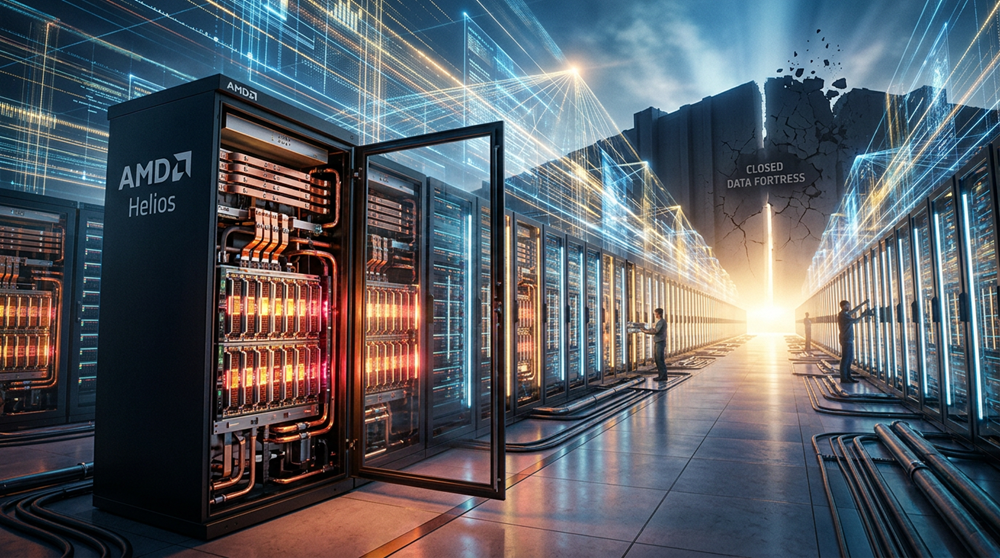
AMD took the exact opposite path, fostering an open, collaborative ecosystem where partners are treated as co-architects rather than captive buyers. Look no further than the newly unveiled AMD Helios Rack-Scale Architecture and the Helion Agentic AI rack designs. Built directly on Meta’s Open Compute Project (OCP) Open Rack Wide (ORW) specification, AMD isn’t forcing proprietary lock-in on the data center. Instead, they are uniting the entire industry behind open standards:
- Ultra Accelerator Link (UALink) and UALoE: Instead of proprietary interconnects, AMD uses UALink over standard Ethernet (UALoE) to connect up to 72 Instinct GPUs and EPYC CPUs in a single rack with 260 TB/s of aggregate scale-up bandwidth across a resilient, single-hop standard Ethernet switch fabric.
- Ultra Ethernet Consortium (UEC): Leveraging AMD Pensando “Vulcano” 800 Gbps AI NICs with PCIe Gen 6, delivering over 50% more scale-out bandwidth than competing proprietary fabrics.
- Deep OEM and Cloud Co-Design: Whether partnering with Oracle Cloud Infrastructure (OCI) on next-gen Compute E7 instances or working directly with HPE on MEXT-ready servers, AMD enables OEMs and ODMs to differentiate their own hardware rather than commoditizing them into white-box assemblers.
When a dominant vendor stumbles – as NVIDIA is doing right now – customers trapped in a proprietary ecosystem look for the exit door. Because AMD built the open standard lifeboats alongside Meta, Microsoft, Oracle, Cisco, and HPE, migrating workloads to AMD doesn’t mean trading one cage for another; it means regaining infrastructure sovereignty.
Deep Dive: How 6th Gen EPYC “Venice” Obliterates the Competition
Software and open ecosystems only matter if the underlying silicon can deliver, and AMD’s 6th Gen EPYC Venice processors are an engineering masterclass. As the industry’s very first data center CPU built on TSMC’s 2nm (N2P) node paired with CoWoS-L advanced packaging on the new SP7 platform, Venice represents a generational leap that leaves both Intel and NVIDIA gasping for air.
Zen 6 delivers a massive 27% average IPC (Instructions Per Cycle) uplift over Zen 5 across enterprise, cloud, and AI workloads. AMD achieved this by completely overhauling the core microarchitecture – expanding the op-cache to serve 18 micro-ops per cycle (up from 12), enlarging the physical register file to 352 entries, enhancing dual 512-bit vector execution engines, and doubling the core density of its dense Core Complex Dies (CCDs) to 32 cores per CCD on Zen 6c (and 12 cores per CCD on standard Zen 6).
The flagship lineup tells a devastating story for the competition:
- AMD EPYC 9996 (The Density King): Packing 256 Zen 6c cores and 512 threads per socket (1,024 threads in a dual-socket server) with up to 1,024MB of L3 cache and 16-channel DDR5 support, this chip delivers up to a 93% gen-on-gen performance gain.
- AMD EPYC 9686F (The High-Frequency Beast): A 96-core powerhouse that drives 1.8x to 1.9x higher AI inference output throughput when paired with accelerators compared to 5th Gen Turin. Furthermore, AMD’s new FAST (Frequency and Core Partitioning) feature allows operators to dynamically split a single 96-core socket into multiple virtual SKUs – running 32 “premium” cores at up to 5.0 GHz while running 64 “batch” cores at an ultra-efficient 2.0 to 2.4 GHz.
- AMD Venice-X (The 3D V-Cache Return): Slated to follow on the roadmap with 96 Zen 6 cores, a staggering 1,152MB of cache, PCIe 6.0, 1.6 TB/s of memory bandwidth, and a blistering 5.3 GHz max boost clock – eliminating the historical trade-off between high clock speeds and massive 3D stacked cache.
How does Venice stack up against its direct rivals?
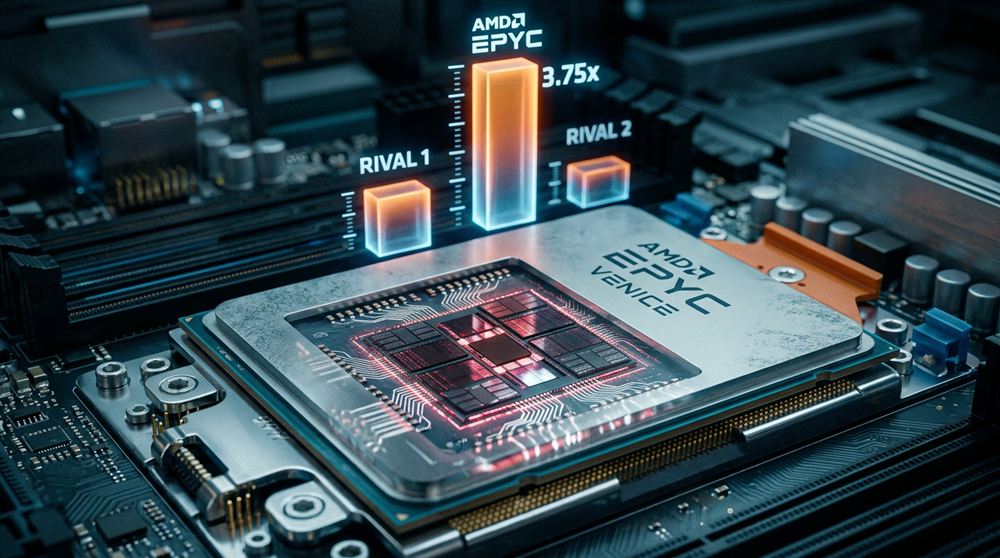
- Venice vs. NVIDIA Vera & Grace: NVIDIA touted its monolithic, 88-core Arm-based Vera CPU (and its predecessor Grace) as an “Apple moment” that would leapfrog x86 in the data center. Independent testing proves otherwise. Because Vera is locked into an 88-core monolithic design, it simply cannot scale. In dual-socket SPECrate 2017 integer evaluations, the 256-core EPYC 9996 scored 5,470 points compared to just 1,459 for NVIDIA’s Vera – a 3.75x performance blowout. Even in head-to-head HPC benchmarks against the 96-core EPYC 9686F, Venice delivers 13% higher raw performance and superior performance-per-watt while outclassing Vera by 20% per core and over 2x at the platform level in agentic AI orchestration. Vera’s only saving grace is being tethered directly to NVIDIA GPUs, and with UALink leveling that playing field, standalone Vera is dead in the water.
- Venice vs. Intel Xeon 6 (Granite Rapids & Clearwater Forest): Intel’s 6th Gen Xeon 6980P (Granite Rapids-AP, 128 cores) is simply outgunned by a full process node and architectural generation. Across a geometric mean of enterprise benchmarks, the EPYC 9996 delivers 2.74x higher performance than the Xeon 6980P—including 3.45x faster planning and orchestration in TPCx-AI and 2.83x higher NGINX web gateway throughput. In computational fluid dynamics and HPC, AMD’s 96-core 9686F beats Intel’s 128-core flagship by 1.6x despite having 32 fewer cores. Even Intel’s dense E-core Clearwater Forest projections cannot match the IPC, thread density, and core-to-core latency discipline of Venice’s 32-core Zen 6c CCDs.
The Next Five Years: Reshaping the Data Center Dynamic (2026–2031)
The convergence of AMD’s Venice launch, the MEXT memory revolution, and NVIDIA’s leadership crisis will fundamentally alter data center architecture over the next five years.
First, we are witnessing the Shift from GPU-Centric Training to CPU-Heavy Agentic AI. During the first wave of generative AI (2023–2025), data centers were essentially giant GPU furnaces where the CPU merely acted as a traffic cop feeding data to accelerators. As we move toward 2030 – a period where AMD rightly projects the data center CPU market alone will balloon to $220 billion – the workload is shifting to Agentic AI. Autonomous AI agents don’t just generate tokens on a GPU; they spin up secure sandboxes, query relational databases, execute code, orchestrate APIs, and run complex planning loops. All of that happens on the CPU. With Venice packing 512 threads per socket and delivering 1.18x more agent sandboxes per rack within strict 35kW power envelopes, the x86 server CPU is reclaiming its throne at the center of the data center budget.
Second, Software-Defined Memory Tiering Will Become Mandatory. Between now and 2031, physical DRAM will transition from a “store everything” medium into an expensive L4 cache that holds only hot data. AMD’s MEXT (and similar KV-cache tiering efforts) will change how servers are specified. By 2028, when AMD rolls out 7th Gen EPYC “Florence” (Zen 7 on A14) with AI Compute Extensions (ACE), followed by 8th Gen “Ravenna” (Zen 8) in 2030, virtually every enterprise server will utilize local AI engines to blend DDR5/DDR6 with CXL and PCIe Gen 6/7 NVMe flash, permanently lowering the total cost of ownership (TCO) for memory-intensive computing.
Finally, The Era of Single-Vendor Lock-In Is Over. NVIDIA will certainly not vanish; its engineering talent and installed base remain formidable. However, without Jensen Huang’s singular hand holding the ecosystem in line, hyperscalers and enterprise CIOs will aggressively diversify to mitigate governance and supply chain risk. Over the next five years, open standards – UALink, Ultra Ethernet, and OCP Helios racks—will win the war against proprietary fabrics. AMD is no longer the scrappy underdog nipping at the heels of giants; with Venice, MEXT, and Lisa Su’s steady hand at the wheel, AMD is now the pacesetter defining the modern data center.
Wrapping Up
In the ruthless arena of enterprise technology, dominance is never permanent, and complacency – whether architectural or personal – is always fatal. NVIDIA’s sudden leadership upheaval has exposed the fragility of an empire built around a single persona and a closed ecosystem, creating a massive vacuum of trust at the exact moment the AI revolution is pivoting toward complex, multi-agent enterprise workloads. AMD has stepped into that breach with flawless execution. Under the steady, drama-free leadership of Dr. Lisa Su, AMD hasn’t just delivered the undisputed performance champion of the server world with its 2nm Zen 6 Venice EPYC processors – outclassing both Intel’s Xeon 6 and NVIDIA’s Vera by wide margins – it has also solved the data center’s crippling DRAM crisis with its ingenious MEXT predictive memory software. By pairing generational silicon leadership with an open, collaborative ecosystem that empowers rather than locks in partners, AMD has seized the strategic initiative. For the next five years, the road to the future of the AI data center runs squarely through Lisa Su and AMD.

- AMD’s Venice Triumph: How Lisa Su and MEXT Are Reshaping the Post-Huang Data Center - November 14, 2026
- Prescription for the Edge: Why HP Looked Beyond Silicon Valley to Find Its Next CEO - November 14, 2026
- Why Lenovo’s Qira Will Succeed Where Past Digital Assistants Failed: The Biometric Companion Revolution - November 4, 2026