We are standing on the precipice of a monumental shift in how humans interact with machines. For over four decades, the personal computer has been a fundamentally passive device. It waits for a keystroke, a mouse click, or a touch command before doing exactly—and only—what it is told. Even the early iterations of artificial intelligence, including the first wave of cloud-based large language models (LLMs), operated on this call-and-response paradigm. You prompt, it answers. You ask for a summary, it provides one. But the device itself remains an interface, a gateway to compute power rather than an independent actor.
That era is ending. Welcome to the “Agentic” Computing Era.
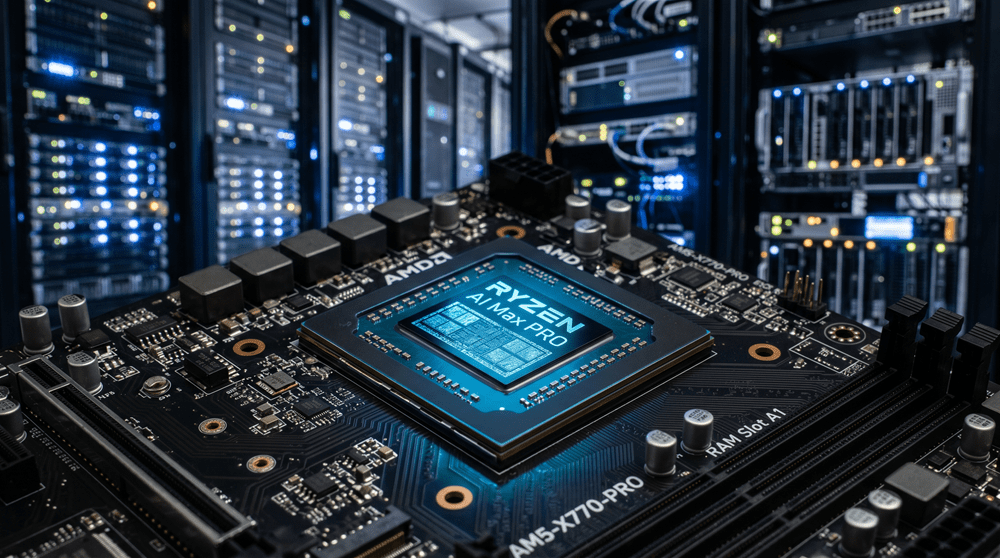
Driven by exponential leaps in local neural processing capabilities, the PC is evolving into an active participant. Hardware vendors and OEMs are rapidly pivoting toward systems designed not just to answer queries, but to understand complex goals, plan logical steps, and execute multi-step workflows autonomously. The catalyst for this transformation in the latter half of 2026 is the rollout of advanced silicon capable of heavy-duty, localized inferencing. Leading this charge, as detailed in their latest architectural deep-dive, AMD powers next-generation Agent Computers with new Ryzen AI HAL, specifically pointing to the highly anticipated AMD Ryzen AI Max PRO 400 series rolling out in Q3. This new silicon is enabling partners like HP and Lenovo to build true “Agent Computers” – workstations that bring the power of autonomous AI securely to the edge.
Understanding the Agentic Computing Era
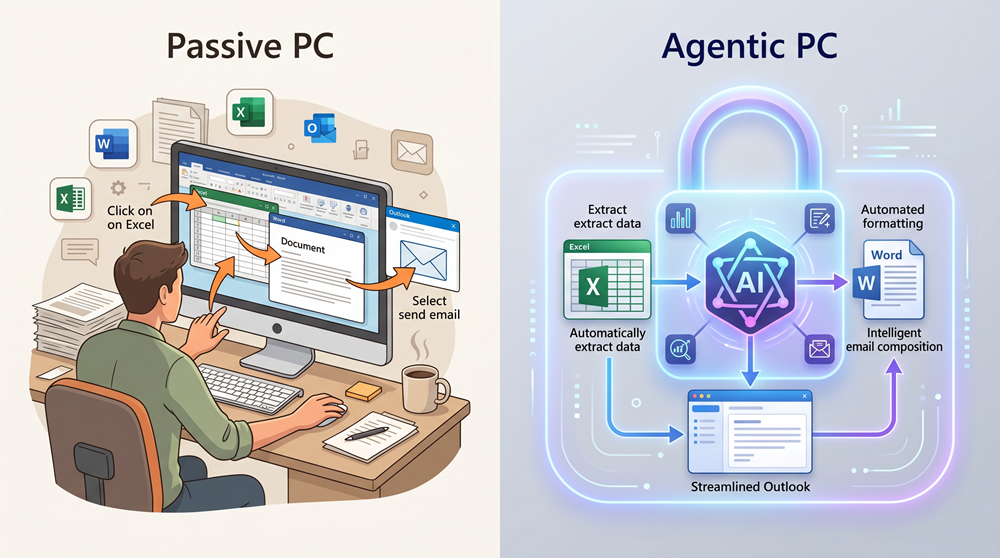
To understand why the Agentic Computing Era is so critical, we must distinguish between an “assistant” and an “agent.” An assistant requires constant supervision and micro-management. An agent operates with a degree of autonomy. In computing terms, an agentic system can receive a high-level directive – such as, “Analyze last quarter’s sales data, compare it against our current inventory, and draft an email to the supply chain team highlighting potential shortfalls for Q4” – and execute it without further human intervention.
Historically, executing tasks of this complexity required shuttling massive amounts of corporate data back and forth to a cloud-based LLM. This approach introduced unacceptable latency, exorbitant API costs, and severe data privacy risks. The Agentic Computing Era solves this by bringing the cognitive engine down to the local hardware. By utilizing powerful Neural Processing Units (NPUs) like those in the Ryzen AI Max PRO 400 series, the PC itself becomes the brain. It can look across your local files, understand your application ecosystem, and securely orchestrate actions right on the desktop.
The Stages of the Agentic Evolution
This transformation will not happen overnight. Much like the deployment of autonomous driving technology, agentic computing will evolve through distinct, highly measurable stages.
Stage 1: Assistive Automation (The Present) We are currently exiting this phase. In Stage 1, AI tools are heavily siloed within specific applications. You have an AI that writes code in your IDE, an AI that summarizes text in your word processor, and an AI that touches up photos in your image editor. They are helpful, but they lack context outside of their specific domain. The user is still the primary orchestrator, manually ferrying data between these disconnected smart tools.
Stage 2: Cross-Application Orchestration (Q3 2026 – 2027) This is the stage unlocked by the Ryzen AI Max PRO 400 series and the new breed of HP and Lenovo Agent Computers. In this phase, the AI sits at the operating system layer, equipped with a hardware abstraction layer (HAL) that allows it to seamlessly interact with the entire software stack. The agent can “see” your screen, understand your calendar, read your incoming messages, and take actions across different applications. If an urgent email arrives from the CEO requesting a project update, a Stage 2 agent can autonomously fetch the latest project timeline from a local management tool, draft a response, and queue it for your approval.
Stage 3: Proactive Autonomy (2028 and Beyond) In the final stage, the agent transitions from reactive to proactive. By continuously learning from your localized data and work habits, the Agent Computer begins anticipating needs before you articulate them. It will automatically dial into meetings, take notes, identify action items, and assign them in your task tracker. It will notice if you are double-booked and proactively negotiate with the other party’s agent to reschedule. At this stage, the PC functions more like a chief of staff than a traditional computer.
User and Enterprise Benefits Across the Stages
For the individual end-user, the benefits are intimately tied to cognitive load reduction. Modern knowledge workers spend a devastating amount of their day engaged in “work about work” – finding files, formatting data, switching context between dozens of SaaS applications, and managing communications. Agentic computing reclaims this time. By offloading routine, multi-step digital chores to a local agent, the user is freed to focus on high-value, strategic, and creative work.
For the enterprise, the benefits are even more profound, primarily centered around security, cost, and standardized productivity. According to insights from Gartner’s AI research, moving AI workloads from the cloud to the edge is a critical priority for enterprise CIOs.
During Stage 1, enterprises struggled with the “Shadow AI” problem – employees pasting sensitive corporate IP into public cloud models to get their work done. Stage 2 Agent Computers solve this instantly. Because the Ryzen AI Max PRO 400 series can handle massive parameters locally, corporate data never has to leave the device. This local execution guarantees compliance with strict data privacy regulations (like GDPR or HIPAA) while entirely eliminating the variable cloud compute costs associated with per-token API pricing. In Stage 3, enterprises will see a homogenization of productivity. A new hire equipped with a proactively autonomous Agent Computer will instantly perform at the level of a seasoned veteran, as the local agent guides them through company-specific workflows.
Comparing the Evolution: Historical Context
To grasp the magnitude of the agentic shift, we must look backward. This evolution is functionally analogous to the transition from the Command Line Interface (CLI) to the Graphical User Interface (GUI) in the 1980s and 1990s.
Before the GUI, computers required users to speak the machine’s language. You had to memorize specific syntax and commands to achieve even basic outcomes. The GUI abstracted that complexity away, replacing syntax with spatial metaphors – desktops, folders, and trash cans. It democratized computing because users no longer had to think like computers.
The shift to agentic computing is the next logical leap. If the GUI changed how we told the computer what to do, the Agent Computer changes who figures out how to do it. You no longer need to know which application to open, which menu to pull down, or which macro to run. You simply state your intent, and the agent translates that intent into a sequence of programmatic actions. Just as the GUI created the modern knowledge worker, the Agent Computer will create the “augmented professional” – a worker capable of outputting the equivalent of a small team.

Preparing for the Wave: Actionable Steps for IT Buyers
This is not a technology transition that corporate IT can afford to sit out or delay. The introduction of Agent Computers by HP and Lenovo in late 2026 represents a hard inflection point in endpoint lifecycle management. Corporate buyers and CIOs must take specific actions immediately to prepare for this wave.
First, an urgent audit of the hardware refresh cycle is required. Traditional x86 processors without robust NPUs will be completely incapable of running Stage 2 and Stage 3 agentic workflows locally. IT buyers must revise their minimum hardware specifications immediately. For any deployment scheduled for late 2026 or 2027, prioritizing silicon specifically designed for autonomous workloads—such as AMD’s new Ryzen AI Max PRO 400 – is no longer optional; it is mandatory.
Second, corporate buyers need to establish a new framework for endpoint security and governance. While local execution solves cloud data leakage, it introduces a new paradigm: managing what the local agent is allowed to do. IT must deploy endpoint management solutions that dictate the “blast radius” of an agent. Can the agent send emails externally, or only internally? Can it execute financial transactions? Setting these guardrails now, before the hardware lands on user desks, is vital.
Timing is of the essence. Organizations should be securing pilot allocations of these HP and Lenovo Agent Computers in Q3 2026, running controlled beta groups in Q4, and preparing for widespread enterprise deployment in the first half of 2027.
The Risks of Failing to Act
The risks of not preparing correctly, or missing the timing of this shift, are existential for modern businesses. The most immediate risk is a massive loss of competitive parity. If your competitors equip their sales, marketing, and engineering teams with Agent Computers capable of automating 40% of their daily workflows, their operational velocity will exponentially outpace yours. You will be fighting a war of attrition armed with passive tools while your competitors leverage active digital workforces.
Furthermore, ignoring the shift to local edge computing will result in spiraling IT costs and security breaches. If you do not provide employees with highly capable local agents, they will inevitably turn to unapproved, cloud-based consumer AI tools to manage their workloads. This “Shadow AI” behavior will result in your most sensitive corporate data being ingested into public models, leading to devastating IP loss and regulatory fines. Relying on cloud-based enterprise solutions for every AI task will simultaneously drain IT budgets through unpredictable API consumption costs.
Wrapping Up
The transition from a passive interface to an active, agentic participant is the most significant evolution in personal computing since the advent of the internet. By moving the cognitive capabilities from the cloud to the local hardware, the industry is fundamentally reshaping the relationship between knowledge workers and their tools.
With AMD’s Q3 rollout of the Ryzen AI Max PRO 400 series, and the subsequent launch of purpose-built Agent Computers from tier-one OEMs like HP and Lenovo, the theoretical has become tangible. These machines are not just faster; they are functionally different. They understand context, they plan sequentially, and they execute autonomously. For the enterprise, this promises a golden age of productivity, provided that IT leadership recognizes the shift and provisions the correct hardware to support it. The Agentic Computing Era is not approaching – it has arrived. Those who recognize it and adapt their endpoint strategies today will define the next decade of corporate efficiency; those who treat the PC as a mere screen will inevitably be left behind.

- Building the Ultimate AI-Defiant Workforce: The Future of Work Mega-Platform - September 30, 2026
- The AI Tipping Point: How AMD’s MLPerf 6.1 Results Signal the End of Nvidia’s Monopoly - September 29, 2026
- AMD Achieves Datacenter Compute Power At IFA 2026, but Local Production Scaling Remains Difficult - September 28, 2026