Podcast: Play in new window | Download
Subscribe: Apple Podcasts | RSS
Every time I pull up directions on my phone, I’m using something the government built. GPS started as a Department of Defense project and was run for decades by the Air Force, the same branch I served in. The internet traces back to a Pentagon research program. A lot of the technology that made Silicon Valley rich was paid for by taxpayers long before anyone figured out how to put an app store on top of it.
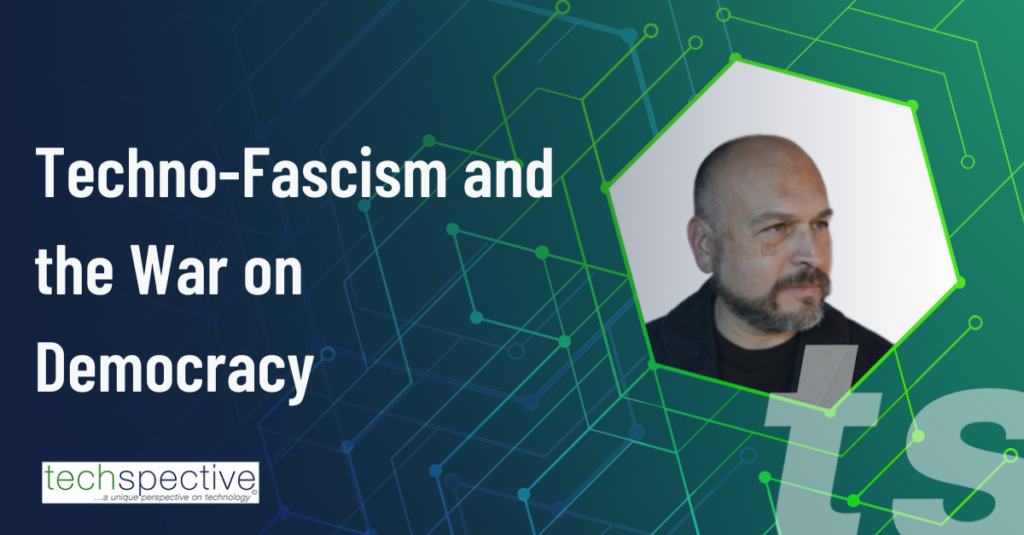
That history matters when the people who got rich on that foundation start talking about tearing down the system that built it. Gil Durán, author of The Nerd Reich: Silicon Valley Fascism and the War on Democracy, joins me on this episode of the TechSpective Podcast to talk about a group of tech billionaires who see democracy as an obstacle and technology as the tool for getting around it.
Built on Public Money
Durán describes many of these figures as government welfare kings, pointing to how much of their wealth traces back to public money. Peter Thiel rails against government, yet he co-founded Palantir in 2003, and the company’s business runs heavily on contracts with intelligence agencies and law enforcement. Elon Musk’s companies have been fueled by billions in government contracts and subsidies. The idea that these men can now opt out of the public and go build something better on their own is, in Durán’s words, “a laughable little boy fantasy.”
None of the underlying ideas are secret, either. They’ve been laid out in blog posts, podcasts and investor letters for more than a decade, and for most of that time they were treated as billionaire eccentricity. I’ll admit I’m guilty as well. I’ve spent a couple of decades in tech and cybersecurity circles; I’d heard rumors and whispers of a lot of this, and I dismissed it as rich guys saying weird things. Meanwhile, those ideas moved from the fringe into the second Trump administration.
Surveillance Nobody Voted For
Aside from the existential threat to democracy itself, I also think a lot about the data privacy implications. Last year, I talked with Chris Inglis, the former deputy director of the NSA (I accidentally referred to him as head of the CIA when talking to Durán), about the Edward Snowden revelations. His position was essentially that yes, the data was collected, but it wasn’t being used for the insidious things people feared. My immediate thought, though, was that even if you take that at face value for 2012, the data still exists, and the people with access to it, and their intentions, can change.
Case in point: today we have Palantir, Flock license plate cameras and DOGE teams that walked into federal agencies and pulled data out, and those tend to get covered as separate stories. I see them as one connected system. Private companies can collect and combine information in ways the government legally can’t, then sell or share it right back, which turns a public-private partnership into a way around the Constitution and data privacy guardrails. Durán calls these supposed libertarians government surveillance libertarians, and he sees growing resistance to it from voters on the right as well as the left.
Owning the Pipes
Surveillance is only one piece. A handful of billionaires now own or control major social platforms, newspapers, TV networks and movie studios, and in Musk’s case, the satellite network an entire military depends on.
Ukraine has found out what that means more than once. Walter Isaacson’s biography of Musk describes him refusing a 2022 Ukrainian request to enable Starlink near Crimea for a drone attack on Russia’s fleet, and Reuters later reported, citing unnamed sources, that he ordered coverage shut off over part of Kherson during Ukraine’s counteroffensive that fall. Musk has denied turning off terminals.
It happened again this month. In mid-October, right after Russian missile strikes on Kyiv, Ukrainian officials said Starlink was suddenly limited for terminals moving faster than 100 mph, which hobbled the drones Ukraine relies on to fight back. Musk first posted that any limits on speed or usage were decided by the U.S. military and ultimately the president. Then on October 24, he said SpaceX had closed a “loophole” that let Ukraine use the civilian service for offensive drone strikes. President Zelenskyy said speeds were restored that same day, after more than a week of disruption he’d warned would cost a lot of lives. Whatever you think of the terms-of-service argument, one company owner was able to dial a country’s battlefield communications up or down in the middle of a war, and the public explanation changed depending on the day.
When that same concentration of wealth floods into elections, Durán argues the math stops working for democracy. “We can have billionaires, or we can have democracy. We can’t have both,” he said.
That’s a blunt way to put it, and plenty of people will push back on it. I don’t think you have to agree with every word to see the pattern, though. When the same few people own the communication channels, the data, the infrastructure, and a growing share of the politicians, voting still happens, but the choices on the ballot and the information people use to make them have already been shaped.
With the midterms a week away, a lot of people are focused on the 2026 election. Durán’s view, however, is that this fight will run much longer than one or two election cycles. Pulling public power back from private hands will take years of pressure on the people we elect, starting with asking which billionaires are paying for their campaigns.
Watch or listen to the episode for the full conversation:
- The Billionaires Who Want to Outgrow Democracy - October 28, 2026
- Patching PHP Is Only Half the Job - October 21, 2026
- Why Your Home Address Is the Privacy Risk That Matters Most - October 21, 2026