The annual Computex trade show in Taipei has always served as the definitive staging ground for personal computing warfare. It is the place where silicon vendors and original equipment manufacturers (OEMs) look each other in the eye, lay their heavy artillery on the table, and attempt to redraw the map of the industry. This year, the overarching theme was not just incremental speed gains or minor battery improvements. Instead, the focus converged entirely on the rapid evolution from experimental artificial intelligence to decentralized, localized, “agentic” applications.
Historically, companies that try to jam workstation-class graphics into an ultrathin chassis end up with something that sounds like a jet engine, burns your lap, and dies within two hours. If you wanted heavy-duty computing, you carried a brick. If you wanted portability, you compromised on performance.
At Computex 2026, HP effectively threw that old playbook out the window. Through an expanded partnership with NVIDIA, HP announced a dramatic reinvention of its consumer and professional lineups by previewing the world’s thinnest laptops powered by the new NVIDIA RTX Spark™ platform. Specifically embodied in the newly redesigned HP OmniBook Ultra 16 and the remarkably compact HP OmniBook X 14, this launch isn’t just a routine hardware refresh; it marks a strategic pivot that redefines the modern premium PC ecosystem.
Decoding NVIDIA RTX Spark
To understand why this launch is a seismic shift for HP, we first have to unpack what NVIDIA RTX Spark actually is. For the last two years, the industry has been obsessed with Neural Processing Units (NPUs) built into standard CPUs. While NPUs are fantastic for low-power, lightweight tasks like blurring your background on a Zoom call or handling text-to-speech, they hit a hard wall when tasked with running dense, localized large language models (LLMs) or complex image diffusion pipelines.
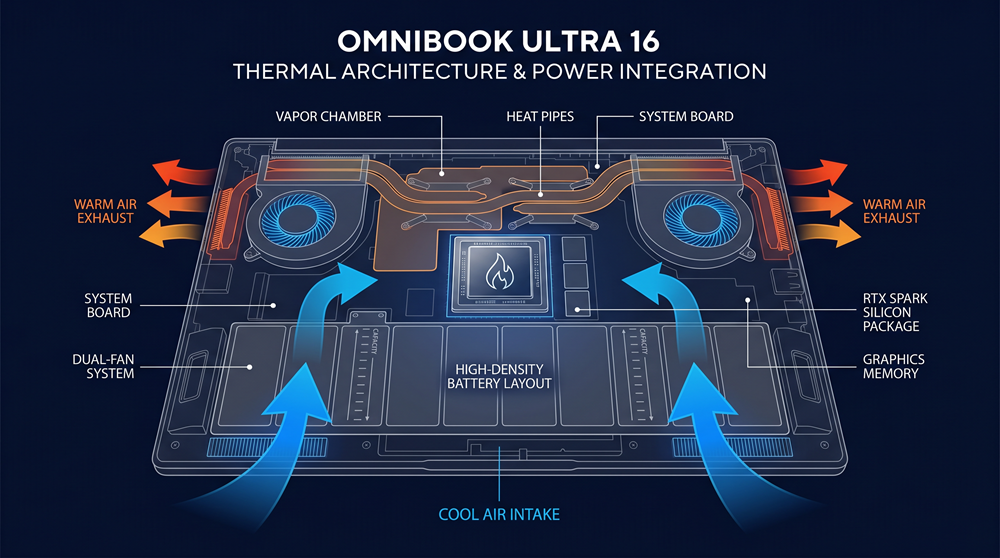
NVIDIA RTX Spark bridges this gap by bringing full-stack AI supercomputing architectures down into highly constrained, thermally sensitive form factors. It combines specialized, ultra-efficient Tensor Cores with advanced architectural power-gating, allowing a machine to output massive amounts of AI compute (measured in hundreds of TOPS, or Tera Operations Per Second) without instantly exhausting the battery.
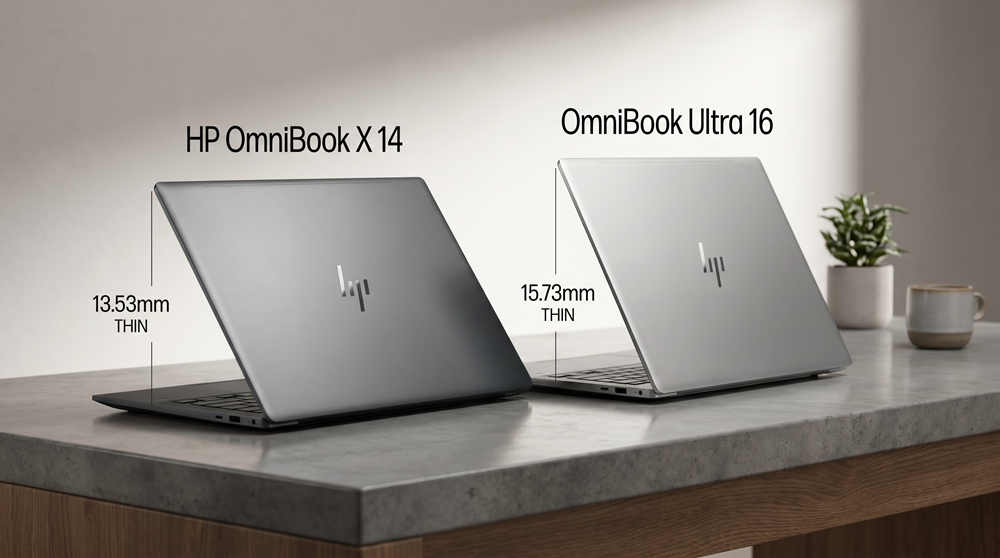
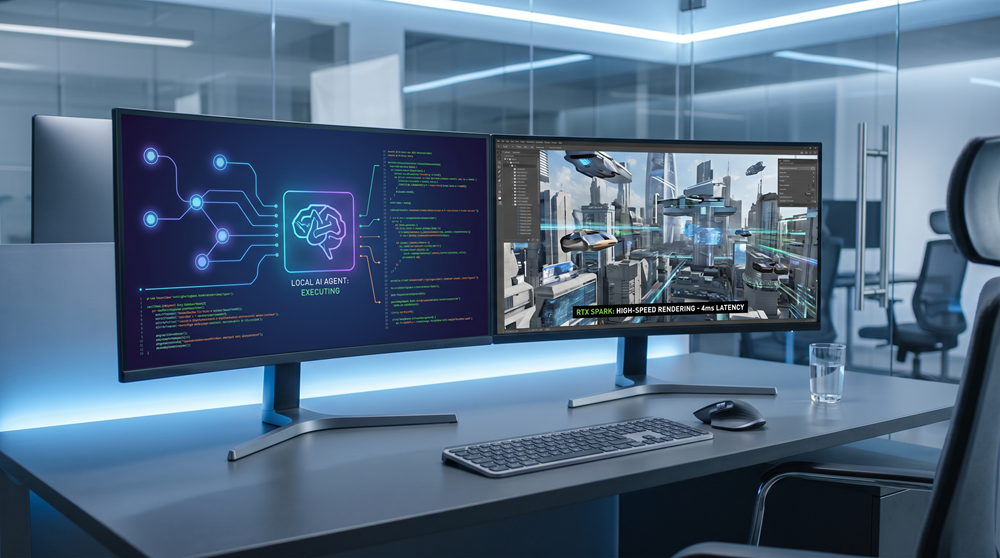
More importantly, Spark is a software-hardware symbiosis. It integrates NVIDIA’s full-stack AI platform directly with local development environments. Instead of relying on a constant, high-latency cloud connection to process user queries, an RTX Spark-equipped machine can run local autonomous “agents” – independent AI programs capable of executing multi-step workflows, parsing massive local datasets securely, and creating complex content entirely on-device. It achieves this while maintaining a thermal envelope that permits unprecedentedly thin physical designs, with the OmniBook X 14 measuring an astonishingly slim 13.53 millimeters at its rear height, and the larger OmniBook Ultra 16 coming in at just 15.73 millimeters.
The Target Audience: Who Needs This Much Power?
The target demographic for these new OmniBook machines is precise, highly lucrative, and historically underserved by standard thin-and-light notebooks. HP is aiming directly at three distinct classes of users:
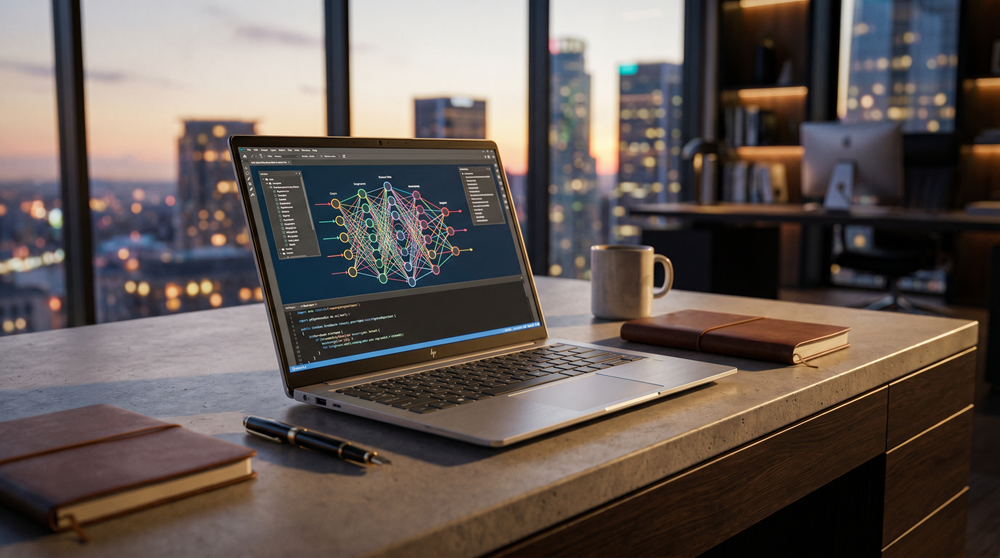
- AI Practitioners and Developers: In the past, if you wanted to build, test, and run agentic frameworks (like Hermes or OpenClaw-based starter kits), you either had to rent expensive cloud compute time or sit at a massive, noisy desktop workstation. The OmniBook Shift architecture gives developers an uncompromised, portable environment where they can write, compile, and run localized models securely while sitting in a coffee shop or flying across the country.
- Advanced Digital Creators: Video editors, 3D artists, and graphic designers have long been forced to carry heavy gaming laptops or thick mobile workstations to get dedicated GPU performance. The RTX Spark implementation gives them the rendering muscle and generative AI acceleration they require inside an elegant, executive-class notebook that doesn’t look out of place in a corporate boardroom.
- Enthusiast Gamers: While not marketed purely as “gaming rigs” under HP’s HyperX or OMEN banners, these OmniBook machines possess the raw graphical horsepower and DLSS capabilities inherent to the RTX architecture. This allows users to seamlessly transition from heavy professional coding workflows to high-fidelity, triple-A gaming on a single, ultra-portable device.
By targeting these power users, HP is positioning the OmniBook brand as the ultimate vehicle for productivity, effectively capturing the high-margin, premium tier of the consumer and prosumer markets.
The Architectural Salvation of HP’s Product Strategy
To understand the broader implications of this announcement, you have to look at HP’s historical positioning. For years, HP wrestled with a highly fragmented naming convention that left customers scratching their heads. You had Envy, Spectre, Pavilion, Dragonfly, and EliteBook—all competing for similar mindshare. The consolidation into the “Omni” prefix for consumer lines (OmniBook for laptops, OmniDesk for desktops) was a much-needed housecleaning.
However, a unified brand is only as good as the flagships that define it. By anchoring the OmniBook brand to the world’s thinnest RTX Spark laptops, HP elevates the entire family’s prestige. It signals to the market that choosing an OmniBook means choosing cutting-edge AI architecture.
Furthermore, this solves a massive problem for HP’s enterprise sales narrative. As enterprise customers increasingly demand robust data privacy, sending proprietary corporate data up to public AI clouds is becoming an unacceptable compliance risk. By engineering a portfolio optimized for local agents and secure hybrid AI workflows, HP can confidently walk into enterprise IT departments and deliver a complete, secure endpoint solution.
This strategy doesn’t stop at the laptop tier. At Computex, HP proved they are thinking about the full spectrum of developer needs. For environments where a laptop isn’t the right fit, they introduced the HP OmniDesk Mini Desktop PC – the world’s first mini-AI PC featuring Intel Core Ultra Series 3 processors and integrated Thunderbolt Share.
HP Developer Ecosystem (Computex 2026)
- Ultra-Portable: OmniBook X 14 (13.53mm, RTX Spark)
- Pro Creator: OmniBook Ultra 16 (15.73mm, RTX Spark)
- Compact Workspace: OmniDesk Mini (Intel Core Ultra Series 3, Thunderbolt Share)
- Advanced Compute: Z2 Mini G1a (AMD Ryzen AI PRO 400, ROCm Stack)
By pairing this compact, multi-display desk tool alongside the enterprise-grade HP Z2 Mini G1a (which utilizes AMD Ryzen AI PRO 400 series processors and the validated ROCm software stack), HP has constructed a contiguous, highly scalable developer ecosystem. They have built a hardware bridge that spans from a retail-ready 14-inch laptop all the way up to specialized deskside supercomputers.
Competitive Dynamics: The Coming Civil War
The premium PC market is about to get incredibly bloody, and HP’s new additions place them on a fascinating battle line. The competitive field can be broken down into three primary adversarial camps.
First, there is the inevitable comparison to Apple’s MacBook Pro line (M3/M4 Pro and Max). Apple has enjoyed an extended period of dominance in the premium creator space due to the impressive, unified memory architecture of its Apple Silicon. However, Apple’s ecosystem is notorious for its closed-source nature and lagging support for mainstream open-source AI developer frameworks. HP’s RTX Spark machines strike right at Apple’s throat by offering comparable, ultra-thin physical profiles and excellent battery life, but with the massive advantage of NVIDIA’s dominant, industry-standard CUDA ecosystem. For AI developers who rely on frameworks like PyTorch, TensorRT, and platforms like Hugging Face, an open Windows/Linux ecosystem paired with local RTX hardware will always beat a Mac.
Second, HP is drawing a sharp line against standard Copilot+ PCs that rely exclusively on integrated CPU/NPU configurations (such as Qualcomm Snapdragon X Elite or standard Intel/AMD silicon). While those platforms boast impressive battery metrics, their localized AI processing is severely bottlenecked by a lack of high-bandwidth memory and raw tensor execution units. HP is effectively positioning the OmniBook Shift models as a “Tier 2” AI PC class—offering exponentially higher local processing ceilings for users whose workloads would cripple a standard NPU.
Finally, there is the internal battle within the Windows ecosystem against historic rivals like Dell (XPS line) and Lenovo (Yoga/ThinkPad Pro). While Dell and Lenovo will undoubtedly field their own variants of next-generation hardware, HP’s claim to the “world’s thinnest” title gives them an immediate marketing edge. By targeting the tight thermal envelope of 13.53mm, HP is proving that its mechanical engineering and thermal extraction designs are operating at an elite level, forcing competitors to play catch-up.
Wrapping Up
The PC industry has spent the last year screaming about AI, but until now, much of the consumer-facing hardware felt like marketing fluff designed to sell old concepts in shiny new boxes. HP’s showcase at Computex 2026 changes that narrative completely.
By delivering the world’s thinnest RTX Spark laptops via the OmniBook X 14 and Ultra 16, HP has successfully married extreme portability with the absolute gold standard of AI compute silicon. This launch successfully cleans up their consumer branding, establishes a robust, secure edge-computing platform for enterprise buyers, and creates an attractive, high-margin ecosystem that appeals directly to developers, creators, and enthusiasts alike.
Apple should be deeply concerned. Standard NPU-bound laptops have officially been put on notice. HP didn’t just iterate at Computex; they drew a definitive line in the sand, demonstrating exactly what a true, uncompromised AI client device is supposed to look like.